HomeNext IconBlogNext Icon

How to Check if AC Refrigerant Is Low by Diagnosing Symptoms

Design Element | Unlimited Heating Plumbing & Refrigeration Inc

Is Your AC Struggling to Cool? Here's How to Tell if Refrigerant Is Low Before Calling a Technician

Knowing how to check if AC refrigerant is low before calling a technician can save you time, money, and a sweltering afternoon in Moscow, ID. Refrigerant is not consumed like fuel — it circulates in a sealed, closed loop. If levels drop, there is always a physical leak somewhere in the system. In fact, roughly 40% of all cooling service calls trace back to this single root cause. The good news is that several warning signs are visible, audible, and measurable without any special tools — and spotting them early can prevent serious compressor damage.

Here is a quick overview of what to check before you pick up the phone:

  1. Feel the air from your vents — it should be noticeably cold, not lukewarm
  2. Look for ice or frost on the copper refrigerant lines or outdoor unit
  3. Listen for hissing or bubbling sounds near the indoor or outdoor unit
  4. Check your energy bills for unexplained spikes
  5. Run the Delta T test — measure the temperature difference between your return and supply air (a healthy system shows a 15°F–20°F split)
  6. Inspect copper line joints for oily, dark residue (refrigerant carries compressor oil as it escapes)
  7. Notice if your home feels humid even when the AC is running

For a deeper look at other AC issues that might look like refrigerant problems, see our AC Troubleshooting Before Calling a Pro guide.
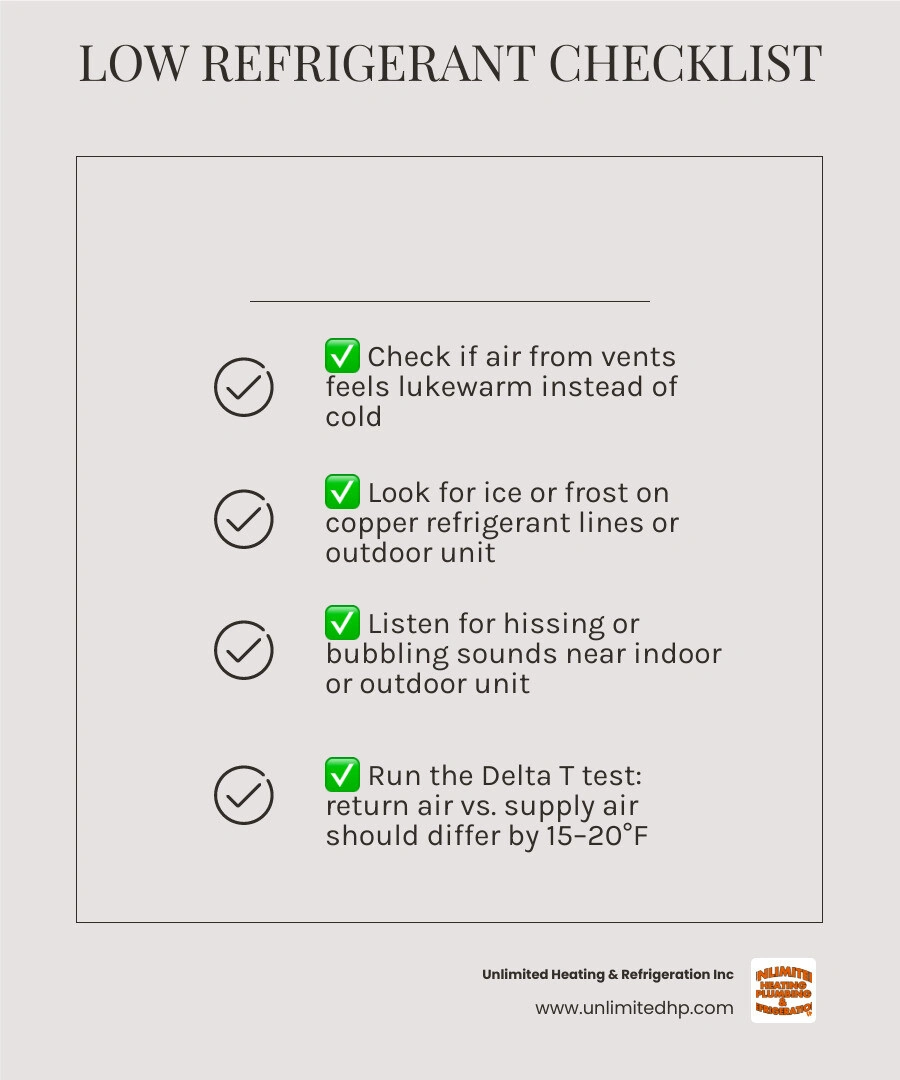
Signs of low AC refrigerant infographic: symptoms, Delta T test, and when to call a pro infographic

How to check if ac refrigerant is low before calling a technician word list:

Common Signs of Low AC Refrigerant

When your air conditioner is running low on its cooling charge, it does not just quietly stop working. It struggles, groans, and sends out several cry-for-help signals. Because the refrigerant is responsible for absorbing the heat from inside your home and dumping it outside, a drop in this vital fluid forces your entire system to work under extreme distress.

When the refrigerant level is wrong, your compressor has to work up to 30% harder and run much longer to cool your home. This translates directly to longer cooling cycles. Instead of the standard 15-to-20-minute cycle on a warm Palouse afternoon, you might notice your outdoor unit humming along for 40 minutes, an hour, or even running continuously without ever reaching your thermostat's setpoint.

This constant operation leads to a noticeable spike in your monthly utility bills. According to the EPA, an incorrect refrigerant level can reduce your system's operating efficiency by 5% to 20%. If you notice your power bills climbing without an obvious change in the weather, your AC might be working overtime to compensate for a leak.

Before you assume the worst, however, it is essential to rule out basic airflow restrictions. A dust-caked, clogged air filter behaves almost identically to a system with low refrigerant. It restricts airflow over the indoor coil, causing the system to lose cooling capacity and even freeze up. Always check and replace your air filter first. If your filter is clean and the system is still struggling, check out our guide on AC Not Cooling But Running – What to Check First to help narrow down the culprits.

How to Check if AC Refrigerant Is Low Before Calling a Technician Using Visual Cues

You do not need a set of professional manifold gauges to spot a refrigerant leak. Your eyes are some of your best diagnostic tools.

First, walk outside to your condenser unit and locate the copper refrigerant lines entering the cabinet. There are usually two lines: a smaller, bare copper line (the liquid line) and a larger, insulated copper line (the suction line). If you see physical ice or frost forming on the brass valves of the outdoor unit or along the exposed parts of the suction line, your system is likely low on refrigerant.

Next, check your indoor evaporator coil if it is safely accessible. Just like the outdoor lines, a low refrigerant charge causes a drop in pressure inside the indoor coil. This pressure drop causes the coil's temperature to plunge below freezing, turning the condensation on the coil into a solid sheet of ice.

Another highly reliable visual cue is the presence of oily residue or dark, dirt-attracting stains along the copper lines, joints, or service valves. Because refrigerant circulates alongside a specific lubricating oil to keep the compressor running smoothly, any physical leak will carry this oil out with the escaping gas. If you spot a greasy, dusty smudge on a copper fitting, you have likely found the exact location of a slow leak. For more help identifying these visual red flags, read our article on No Cold Air – Is Your AC Broken?.

How to Check if AC Refrigerant Is Low Before Calling a Technician with Simple Sound and Airflow Tests

Your ears and your skin can also help you diagnose a low refrigerant charge.

Listen closely to your indoor air handler and your outdoor condenser unit while they are running, and right after they shut off. Because refrigerant is kept under high pressure, a leak in the copper tubing or evaporator coil often produces a distinct hissing or bubbling sound. It can sound like pressurized gas escaping from a bicycle tire or a faint "soda fizzing" sound coming from your indoor utility closet.

Additionally, pay close attention to the air coming out of your supply registers. When refrigerant is low, the air blowing from your vents will feel lukewarm or only slightly cool rather than crisp and cold. You might also notice that the overall airflow feels weaker or that your home remains sticky and humid.

A healthy air conditioner acts as a dehumidifier, pulling moisture out of the air as it cools. When the refrigerant level drops, the system loses its ability to remove moisture effectively, leaving your indoor humidity well above the comfortable 30% to 50% range. If your system is constantly cycling on and off while failing to lower the humidity, you can find more troubleshooting steps in our article AC Keeps Turning On and Off – What Is Wrong.

How to check if ac refrigerant is low before calling a technician Using the Delta T Test

If you want a scientific, highly accurate way to check your system's performance without calling in a pro, you can perform the "Delta T" (temperature split) test. This simple test measures the temperature difference between the air entering your system and the air blowing out of it.

To perform this test properly, ensure the outdoor temperature is at least 70°F. If it is cooler than that outside, there won't be enough of a heat load on the system to give you an accurate reading.

Follow these simple steps:

  1. Turn on your air conditioner and let it run continuously for at least 15 to 20 minutes to allow the system pressures and temperatures to stabilize.
  2. Grab a standard digital thermometer (a probe thermometer or a digital pocket thermometer works best; infrared laser thermometers can work but are less accurate on shiny metal grilles).
  3. Find your main return air grille (where the air enters the system, usually where your large air filter is located) and measure the temperature of the air entering the vent. Write this number down.
  4. Locate the supply vent closest to your indoor air handler or furnace. Measure the temperature of the cold air blowing directly out of this vent. Write this number down.
  5. Subtract the supply air temperature from the return air temperature. The resulting number is your Delta T.

In a properly functioning system, the temperature difference between the return air and the supply air should be between 15°F and 20°F.

Temperature Split (Delta T)What It Likely MeansRecommended Action
Less than 15°FLow cooling capacity. Often caused by low refrigerant or a failing compressor.Schedule a professional inspection to check pressures.
15°F to 20°FNormal, healthy system operation.No action needed; your system is charged and running efficiently.
Greater than 20°FRestricted airflow. Usually caused by a clogged air filter, closed vents, or a failing blower motor.Replace your air filter immediately and ensure all registers are open.

If your Delta T is consistently below 15°F, and you have already confirmed that your air filter is clean, your system is highly likely running low on refrigerant. For homeowners in the Lewiston-Moscow area dealing with these performance drops, you can learn more about local cooling demands in our article on AC Repair Solutions for Lewiston ID Homes.

Why Low Refrigerant Causes Ice on Your AC Lines
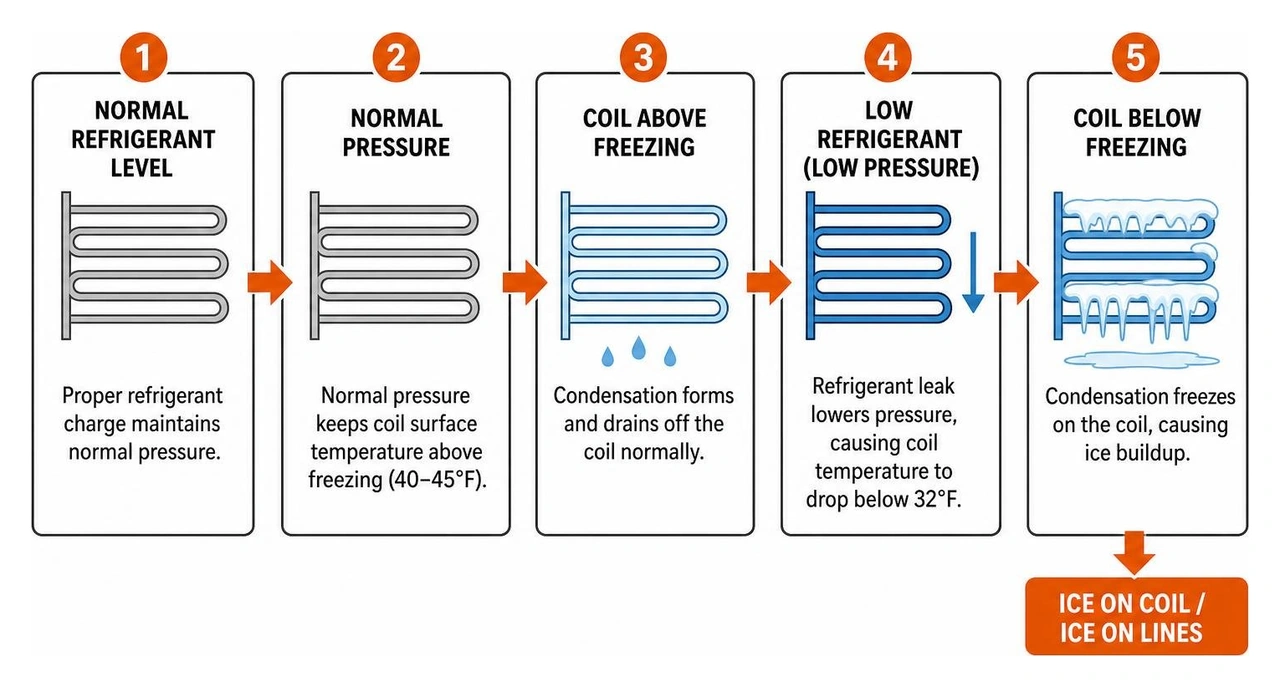
diagram showing how low refrigerant pressure drops the coil temperature below freezing, causing condensation to freeze into

It seems completely counterintuitive: how can a system that is failing to cool your home end up covered in a thick block of ice when it is 90°F outside?

The answer lies in the physics of the refrigeration cycle. Your air conditioner relies on a precise balance of pressure and temperature. When refrigerant levels are healthy, the liquid refrigerant expands into a gas inside the indoor evaporator coil at a pressure that keeps the coil's surface temperature safely above freezing (usually around 40°F to 45°F). This allows the coil to absorb heat from your indoor air while condensation safely drips off the copper fins and down the condensate drain.

However, when a leak causes the refrigerant level to drop, the pressure inside the evaporator coil plunges. According to physical gas laws, a drop in pressure results in a direct drop in temperature. This pressure drop causes the temperature of the coil to fall well below 32°F.

As warm, humid indoor air passes over this sub-freezing coil, the moisture in the air instantly freezes on contact. Over several hours, this thin layer of frost builds up into a thick sheet of ice, completely insulating the coil and blocking all airflow.

Once the indoor coil freezes over, the liquid refrigerant cannot absorb any heat. It travels back down the outdoor suction line as a freezing liquid, causing the outdoor copper lines and brass service valves to freeze as well.

Running your system in this state puts immense strain on your compressor. Compressors are designed to pump gas, not liquid. If liquid refrigerant floods back into the compressor (a dangerous condition known as "liquid slugging"), it can destroy the internal valves and motor, leading to a catastrophic system failure. If your system is older and suffering from frequent freeze-ups, it may be time to read our guide on Signs You Need an AC Replacement.

What Causes Low Refrigerant in a Sealed AC System?

Your air conditioner's refrigerant lines are made of copper, brass, and aluminum, brazed together to form a completely sealed, pressurized loop. Under normal operating conditions, refrigerant is never consumed, worn out, or "used up" like the oil or fuel in your car. If your system is low on refrigerant, it means a physical breach has occurred.

There are several common causes for these leaks:

  • Formicary Corrosion: This is the most common culprit for microscopic pinhole leaks in modern copper coils. Formicary corrosion is a chemical reaction that occurs when household airborne acids (found in cleaning products, paints, cosmetics, and building materials) react with the copper tubing of your indoor coil. Over time, this corrosion eats tiny tunnels through the copper, allowing refrigerant to slowly seep out.
  • Vibration Damage: Your outdoor unit contains a high-powered compressor and fan motor that naturally vibrate during operation. If the copper lines are resting against the metal cabinet or other components without proper shielding, this constant friction can wear a hole directly through the copper wall.
  • Weak Joints and Thermal Expansion: As your system cycles on and off, the copper lines constantly expand and contract due to temperature swings. Over years of service, this thermal expansion can put stress on brazed joints and service valves, eventually causing them to crack or loosen.
  • Physical Damage: Lawn mowers, string trimmers, and yard tools can easily damage the exposed copper line set running along the side of your home if it is not protected by a defensive cover.

Understanding whether to repair a persistent leak or upgrade to a modern, highly efficient system is crucial, especially in our region's climate. Learn how to weigh these options by reading our guide on How to Decide If AC Repair Is Worth the Money in a Hot Inland Climate.

Frequently Asked Questions About AC Refrigerant

No, it is neither safe nor legal for an unlicensed homeowner to purchase or add refrigerant to an HVAC system. Under EPA Section 608 regulations, it is illegal for anyone without proper certification to purchase, handle, or introduce chemical refrigerants into an air conditioner.

Beyond the legal restrictions, attempting a DIY recharge carries severe safety hazards. Refrigerant is stored under extreme pressure and can cause severe chemical burns or instant frostbite if it contacts your skin or eyes. Furthermore, adding refrigerant without professional manifold gauges, scales, and temperature probes risks overcharging the system, which can permanently destroy your compressor.

Does AC refrigerant ever need to be topped off regularly?

No. A healthy, properly installed air conditioner should never need to be "topped off." Because the system is a closed loop, any drop in refrigerant level indicates a physical leak. Simply adding more refrigerant without locating and repairing the leak is a temporary band-aid. It is wasteful, environmentally damaging, and will eventually lead to the same cooling failure. A professional technician should always find and seal the leak before recharging the system.

What is the difference between R-22, R-410A, and R-32 refrigerants?

The primary differences lie in their environmental impact, operating pressures, and chemical makeup:

  • R-22 (Freon): This is an older, chlorine-based HCFC refrigerant commonly used in systems installed before 2010. Because it damages the ozone layer and has a high Global Warming Potential (GWP) of 1,810, the EPA has completely phased it out. It is no longer manufactured or imported, making repairs on older R-22 systems incredibly expensive.
  • R-410A: This is the standard HFC refrigerant used in most residential systems installed over the last fifteen years. While it does not deplete the ozone layer, it still carries a high GWP of 2,088 and is currently being phased down in newer equipment.
  • R-32: This is a next-generation refrigerant used in the latest eco-friendly systems. It operates with a GWP of just 675 — a 67% reduction compared to R-410A — making it highly efficient and much better for the environment.

Conclusion

If you have performed these DIY checks and confirmed that your air conditioner is blowing warm air, freezing up, or showing a Delta T split well below 15°F, it is time to call in the professionals. Running an undercharged system for too long can lead to a burnt-out compressor, turning a straightforward leak repair into a major, expensive system replacement.

At Unlimited Heating & Refrigeration Inc, we have been serving Moscow, ID, Pullman, WA, and the surrounding communities with trusted, family-owned expertise for over 20 years. As a premier Daikin dealer, we stand behind our work with an industry-leading 12-year warranty and our signature Comfort Promise. Our EPA-certified technicians will not just "top off" your system; we will use advanced electronic leak detectors and nitrogen pressure tests to find the root cause, seal the breach, and restore your home's comfort safely and legally.

If you are trying to decide whether to patch up your older system or transition to a modern, energy-efficient model, check out our AC Repair vs Replace Decision Guide to make an informed choice.

Ready to get your cooling back on track? Contact us today to schedule your professional service:

Is Your AC Struggling to Cool? Here's How to Tell if Refrigerant Is Low Before Calling a Technician

Knowing how to check if AC refrigerant is low before calling a technician can save you time, money, and a sweltering afternoon in Moscow, ID. Refrigerant is not consumed like fuel — it circulates in a sealed, closed loop. If levels drop, there is always a physical leak somewhere in the system. In fact, roughly 40% of all cooling service calls trace back to this single root cause. The good news is that several warning signs are visible, audible, and measurable without any special tools — and spotting them early can prevent serious compressor damage.

Here is a quick overview of what to check before you pick up the phone:

  1. Feel the air from your vents — it should be noticeably cold, not lukewarm
  2. Look for ice or frost on the copper refrigerant lines or outdoor unit
  3. Listen for hissing or bubbling sounds near the indoor or outdoor unit
  4. Check your energy bills for unexplained spikes
  5. Run the Delta T test — measure the temperature difference between your return and supply air (a healthy system shows a 15°F–20°F split)
  6. Inspect copper line joints for oily, dark residue (refrigerant carries compressor oil as it escapes)
  7. Notice if your home feels humid even when the AC is running

For a deeper look at other AC issues that might look like refrigerant problems, see our AC Troubleshooting Before Calling a Pro guide.

Signs of low AC refrigerant infographic: symptoms, Delta T test, and when to call a pro infographic

How to check if ac refrigerant is low before calling a technician word list:

Common Signs of Low AC Refrigerant

When your air conditioner is running low on its cooling charge, it does not just quietly stop working. It struggles, groans, and sends out several cry-for-help signals. Because the refrigerant is responsible for absorbing the heat from inside your home and dumping it outside, a drop in this vital fluid forces your entire system to work under extreme distress.

When the refrigerant level is wrong, your compressor has to work up to 30% harder and run much longer to cool your home. This translates directly to longer cooling cycles. Instead of the standard 15-to-20-minute cycle on a warm Palouse afternoon, you might notice your outdoor unit humming along for 40 minutes, an hour, or even running continuously without ever reaching your thermostat's setpoint.

This constant operation leads to a noticeable spike in your monthly utility bills. According to the EPA, an incorrect refrigerant level can reduce your system's operating efficiency by 5% to 20%. If you notice your power bills climbing without an obvious change in the weather, your AC might be working overtime to compensate for a leak.

Before you assume the worst, however, it is essential to rule out basic airflow restrictions. A dust-caked, clogged air filter behaves almost identically to a system with low refrigerant. It restricts airflow over the indoor coil, causing the system to lose cooling capacity and even freeze up. Always check and replace your air filter first. If your filter is clean and the system is still struggling, check out our guide on AC Not Cooling But Running – What to Check First to help narrow down the culprits.

How to Check if AC Refrigerant Is Low Before Calling a Technician Using Visual Cues

You do not need a set of professional manifold gauges to spot a refrigerant leak. Your eyes are some of your best diagnostic tools.

First, walk outside to your condenser unit and locate the copper refrigerant lines entering the cabinet. There are usually two lines: a smaller, bare copper line (the liquid line) and a larger, insulated copper line (the suction line). If you see physical ice or frost forming on the brass valves of the outdoor unit or along the exposed parts of the suction line, your system is likely low on refrigerant.

Next, check your indoor evaporator coil if it is safely accessible. Just like the outdoor lines, a low refrigerant charge causes a drop in pressure inside the indoor coil. This pressure drop causes the coil's temperature to plunge below freezing, turning the condensation on the coil into a solid sheet of ice.

Another highly reliable visual cue is the presence of oily residue or dark, dirt-attracting stains along the copper lines, joints, or service valves. Because refrigerant circulates alongside a specific lubricating oil to keep the compressor running smoothly, any physical leak will carry this oil out with the escaping gas. If you spot a greasy, dusty smudge on a copper fitting, you have likely found the exact location of a slow leak. For more help identifying these visual red flags, read our article on No Cold Air – Is Your AC Broken?.

How to Check if AC Refrigerant Is Low Before Calling a Technician with Simple Sound and Airflow Tests

Your ears and your skin can also help you diagnose a low refrigerant charge.

Listen closely to your indoor air handler and your outdoor condenser unit while they are running, and right after they shut off. Because refrigerant is kept under high pressure, a leak in the copper tubing or evaporator coil often produces a distinct hissing or bubbling sound. It can sound like pressurized gas escaping from a bicycle tire or a faint "soda fizzing" sound coming from your indoor utility closet.

Additionally, pay close attention to the air coming out of your supply registers. When refrigerant is low, the air blowing from your vents will feel lukewarm or only slightly cool rather than crisp and cold. You might also notice that the overall airflow feels weaker or that your home remains sticky and humid.

A healthy air conditioner acts as a dehumidifier, pulling moisture out of the air as it cools. When the refrigerant level drops, the system loses its ability to remove moisture effectively, leaving your indoor humidity well above the comfortable 30% to 50% range. If your system is constantly cycling on and off while failing to lower the humidity, you can find more troubleshooting steps in our article AC Keeps Turning On and Off – What Is Wrong.

How to check if ac refrigerant is low before calling a technician Using the Delta T Test

If you want a scientific, highly accurate way to check your system's performance without calling in a pro, you can perform the "Delta T" (temperature split) test. This simple test measures the temperature difference between the air entering your system and the air blowing out of it.

To perform this test properly, ensure the outdoor temperature is at least 70°F. If it is cooler than that outside, there won't be enough of a heat load on the system to give you an accurate reading.

Follow these simple steps:

  1. Turn on your air conditioner and let it run continuously for at least 15 to 20 minutes to allow the system pressures and temperatures to stabilize.
  2. Grab a standard digital thermometer (a probe thermometer or a digital pocket thermometer works best; infrared laser thermometers can work but are less accurate on shiny metal grilles).
  3. Find your main return air grille (where the air enters the system, usually where your large air filter is located) and measure the temperature of the air entering the vent. Write this number down.
  4. Locate the supply vent closest to your indoor air handler or furnace. Measure the temperature of the cold air blowing directly out of this vent. Write this number down.
  5. Subtract the supply air temperature from the return air temperature. The resulting number is your Delta T.

In a properly functioning system, the temperature difference between the return air and the supply air should be between 15°F and 20°F.

Temperature Split (Delta T)What It Likely MeansRecommended Action
Less than 15°FLow cooling capacity. Often caused by low refrigerant or a failing compressor.Schedule a professional inspection to check pressures.
15°F to 20°FNormal, healthy system operation.No action needed; your system is charged and running efficiently.
Greater than 20°FRestricted airflow. Usually caused by a clogged air filter, closed vents, or a failing blower motor.Replace your air filter immediately and ensure all registers are open.

If your Delta T is consistently below 15°F, and you have already confirmed that your air filter is clean, your system is highly likely running low on refrigerant. For homeowners in the Lewiston-Moscow area dealing with these performance drops, you can learn more about local cooling demands in our article on AC Repair Solutions for Lewiston ID Homes.

Why Low Refrigerant Causes Ice on Your AC Lines

diagram showing how low refrigerant pressure drops the coil temperature below freezing, causing condensation to freeze into

It seems completely counterintuitive: how can a system that is failing to cool your home end up covered in a thick block of ice when it is 90°F outside?

The answer lies in the physics of the refrigeration cycle. Your air conditioner relies on a precise balance of pressure and temperature. When refrigerant levels are healthy, the liquid refrigerant expands into a gas inside the indoor evaporator coil at a pressure that keeps the coil's surface temperature safely above freezing (usually around 40°F to 45°F). This allows the coil to absorb heat from your indoor air while condensation safely drips off the copper fins and down the condensate drain.

However, when a leak causes the refrigerant level to drop, the pressure inside the evaporator coil plunges. According to physical gas laws, a drop in pressure results in a direct drop in temperature. This pressure drop causes the temperature of the coil to fall well below 32°F.

As warm, humid indoor air passes over this sub-freezing coil, the moisture in the air instantly freezes on contact. Over several hours, this thin layer of frost builds up into a thick sheet of ice, completely insulating the coil and blocking all airflow.

Once the indoor coil freezes over, the liquid refrigerant cannot absorb any heat. It travels back down the outdoor suction line as a freezing liquid, causing the outdoor copper lines and brass service valves to freeze as well.

Running your system in this state puts immense strain on your compressor. Compressors are designed to pump gas, not liquid. If liquid refrigerant floods back into the compressor (a dangerous condition known as "liquid slugging"), it can destroy the internal valves and motor, leading to a catastrophic system failure. If your system is older and suffering from frequent freeze-ups, it may be time to read our guide on Signs You Need an AC Replacement.

What Causes Low Refrigerant in a Sealed AC System?

Your air conditioner's refrigerant lines are made of copper, brass, and aluminum, brazed together to form a completely sealed, pressurized loop. Under normal operating conditions, refrigerant is never consumed, worn out, or "used up" like the oil or fuel in your car. If your system is low on refrigerant, it means a physical breach has occurred.

There are several common causes for these leaks:

  • Formicary Corrosion: This is the most common culprit for microscopic pinhole leaks in modern copper coils. Formicary corrosion is a chemical reaction that occurs when household airborne acids (found in cleaning products, paints, cosmetics, and building materials) react with the copper tubing of your indoor coil. Over time, this corrosion eats tiny tunnels through the copper, allowing refrigerant to slowly seep out.
  • Vibration Damage: Your outdoor unit contains a high-powered compressor and fan motor that naturally vibrate during operation. If the copper lines are resting against the metal cabinet or other components without proper shielding, this constant friction can wear a hole directly through the copper wall.
  • Weak Joints and Thermal Expansion: As your system cycles on and off, the copper lines constantly expand and contract due to temperature swings. Over years of service, this thermal expansion can put stress on brazed joints and service valves, eventually causing them to crack or loosen.
  • Physical Damage: Lawn mowers, string trimmers, and yard tools can easily damage the exposed copper line set running along the side of your home if it is not protected by a defensive cover.

Understanding whether to repair a persistent leak or upgrade to a modern, highly efficient system is crucial, especially in our region's climate. Learn how to weigh these options by reading our guide on How to Decide If AC Repair Is Worth the Money in a Hot Inland Climate.

Frequently Asked Questions About AC Refrigerant

No, it is neither safe nor legal for an unlicensed homeowner to purchase or add refrigerant to an HVAC system. Under EPA Section 608 regulations, it is illegal for anyone without proper certification to purchase, handle, or introduce chemical refrigerants into an air conditioner.

Beyond the legal restrictions, attempting a DIY recharge carries severe safety hazards. Refrigerant is stored under extreme pressure and can cause severe chemical burns or instant frostbite if it contacts your skin or eyes. Furthermore, adding refrigerant without professional manifold gauges, scales, and temperature probes risks overcharging the system, which can permanently destroy your compressor.

Does AC refrigerant ever need to be topped off regularly?

No. A healthy, properly installed air conditioner should never need to be "topped off." Because the system is a closed loop, any drop in refrigerant level indicates a physical leak. Simply adding more refrigerant without locating and repairing the leak is a temporary band-aid. It is wasteful, environmentally damaging, and will eventually lead to the same cooling failure. A professional technician should always find and seal the leak before recharging the system.

What is the difference between R-22, R-410A, and R-32 refrigerants?

The primary differences lie in their environmental impact, operating pressures, and chemical makeup:

  • R-22 (Freon): This is an older, chlorine-based HCFC refrigerant commonly used in systems installed before 2010. Because it damages the ozone layer and has a high Global Warming Potential (GWP) of 1,810, the EPA has completely phased it out. It is no longer manufactured or imported, making repairs on older R-22 systems incredibly expensive.
  • R-410A: This is the standard HFC refrigerant used in most residential systems installed over the last fifteen years. While it does not deplete the ozone layer, it still carries a high GWP of 2,088 and is currently being phased down in newer equipment.
  • R-32: This is a next-generation refrigerant used in the latest eco-friendly systems. It operates with a GWP of just 675 — a 67% reduction compared to R-410A — making it highly efficient and much better for the environment.

Conclusion

If you have performed these DIY checks and confirmed that your air conditioner is blowing warm air, freezing up, or showing a Delta T split well below 15°F, it is time to call in the professionals. Running an undercharged system for too long can lead to a burnt-out compressor, turning a straightforward leak repair into a major, expensive system replacement.

At Unlimited Heating & Refrigeration Inc, we have been serving Moscow, ID, Pullman, WA, and the surrounding communities with trusted, family-owned expertise for over 20 years. As a premier Daikin dealer, we stand behind our work with an industry-leading 12-year warranty and our signature Comfort Promise. Our EPA-certified technicians will not just "top off" your system; we will use advanced electronic leak detectors and nitrogen pressure tests to find the root cause, seal the breach, and restore your home's comfort safely and legally.

If you are trying to decide whether to patch up your older system or transition to a modern, energy-efficient model, check out our AC Repair vs Replace Decision Guide to make an informed choice.

Ready to get your cooling back on track? Contact us today to schedule your professional service:

Customer Testimonials

Our customers love our service and support.

Design Element | Unlimited Heating Plumbing & Refrigeration IncDesign Element | Unlimited Heating Plumbing & Refrigeration Inc