HomeNext IconBlogNext Icon

Cheat Sheet to Deciding If AC Repair Is Worth the Money

Design Element | Unlimited Heating Plumbing & Refrigeration Inc

How to Decide If AC Repair Is Worth the Money Before Summer Gets Worse

Knowing how to decide if ac repair is worth the money in a hot inland climate can save you from a costly mistake made under pressure. Here is a quick-reference guide to help you make the right call:

Is your AC repair worth it? Check these five factors:

  1. Apply the Rule of 5,000 - Multiply your system's age (in years) by the repair cost (in dollars). If the result exceeds 5,000, replacement is usually the smarter move.
  2. Check system age - Most AC units last around 10 to 15 years. In hot inland climates with heavy summer use, that lifespan can be shorter.
  3. Know your refrigerant type - If your system uses R-22, repairs are rarely worth it. R-22 is no longer produced, making it scarce and expensive.
  4. Track repair frequency - Three or more service calls in three years is a strong signal that the system is failing systemically, not just experiencing isolated issues.
  5. Look at your energy bills - A 15% or more year-over-year increase in cooling costs often means your system is losing efficiency faster than repairs can fix.

When your AC stops working on a 103-degree afternoon in Moscow, ID, the last thing you want is to make a rushed, expensive decision you will regret. But that is exactly the situation many homeowners find themselves in — staring at a repair quote, not sure whether to approve it or walk away and buy something new.

The problem is that hot inland climates are uniquely hard on air conditioning equipment. Systems run longer, work harder, and wear out faster than they would in cooler or coastal regions. A unit that might last 15 years in a mild climate can start showing serious strain well before the 10-year mark here. That changes the math on what counts as a worthwhile repair.

This guide gives you a clear, honest framework for making that call — without the guesswork or sales pressure.
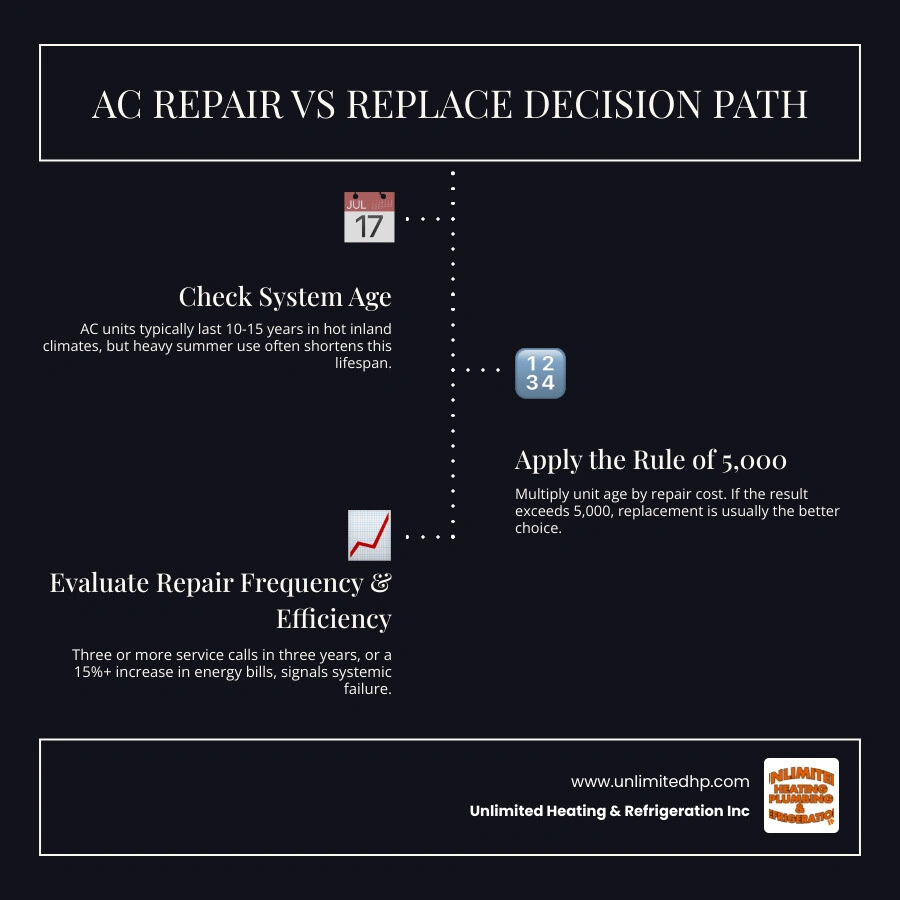
infographic showing AC repair vs replace decision path based on system age repair cost and climate factors infographic

Important how to decide if ac repair is wavelength the money in a hot inland climate terms:

Unique Challenges of Cooling a Home in a Hot Inland Climate

Living in the inland Pacific Northwest — whether in Moscow, Pullman, Lewiston, or Colfax — means experiencing a climate of dramatic extremes. While our winters are freezing, our summers bring intense, dry heat waves that put massive thermal stress on residential air conditioners. Unlike coastal areas that benefit from cooling ocean breezes, inland regions trap heat, forcing cooling systems to run continuously at maximum capacity for weeks on end.

This relentless workload is only half the battle. If you live anywhere near the beautiful rolling hills of the Palouse, you are well acquainted with our signature feature: agricultural dust. During the hot summer harvesting seasons, fine dust from wheat, barley, and lentil fields fills the air.

While this dust is a natural part of our local landscape, it is a silent killer for outdoor air conditioning units. When your system pulls in air to cool down the refrigerant, it also pulls in this fine agricultural dust. This process leads to a few critical issues:

  • Insulated Coils: The dust acts as a thermal blanket over your condenser coils, trapping heat inside the system instead of releasing it.
  • Accelerated Wear: To combat the trapped heat, the compressor and fan motor must work twice as hard and run significantly longer to cool your home.
  • Shortened Lifespan: This combination of extreme thermal stress and heavy dust accumulation can cut years off your system's useful life.

Understanding does extreme heat combined with heavy dust exposure shorten AC lifespan is essential for local homeowners. When a system is forced to run under these punishing conditions, internal components wear out much faster than manufacturer averages suggest.

Furthermore, learning why agricultural dust from the Palouse clogs AC coils faster than average explains why a system that was working perfectly in May might experience a sudden, catastrophic breakdown by August. The dust creates a physical barrier that restricts airflow, driving up internal pressures and temperatures until a critical component fails.

How to Decide If AC Repair Is Worth the Money in a Hot Inland Climate
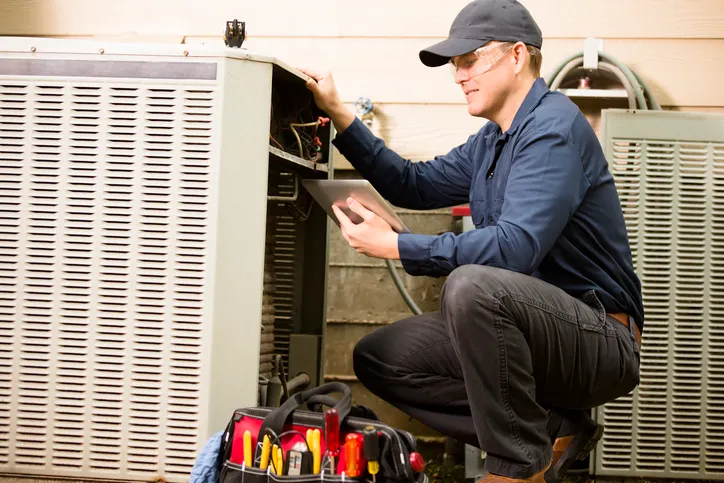
HVAC technician measuring AC performance to evaluate decision framework

When your system acts up during a summer heatwave, you need a reliable method to evaluate whether a repair is a smart investment or simply throwing good money after bad. Making this decision under pressure requires a structured approach that removes emotion from the equation.

To start, we recommend using a balanced decision framework. This framework looks beyond the immediate breakdown to consider the system's overall history, its performance trends, and how hard it has to work in our local climate.

Start by reviewing your service records. Have you had to call a technician out multiple times over the last few summers? In the HVAC world, frequent minor repairs are rarely isolated incidents. Instead, they are often symptoms of systemic wear. If your system is constantly needing new capacitors, fan motors, or contactors, the system is telling you that its primary mechanical assemblies are reaching the end of their operational life.

To help you navigate this complex choice, we have put together a comprehensive AC repair vs replace decision guide that details how to weigh these overlapping issues. It is also vital to understand the tipping point of when a system becomes a financial drain. Our guide on how much AC repair is too much before replacing the unit provides clear benchmarks to help you identify when a repair quote is simply too high to justify on an aging piece of equipment.

Applying the Rule of 5,000 to Determine If AC Repair Is Worth the Money in a Hot Inland Climate

If you prefer a direct, mathematical approach to home maintenance decisions, the Rule of 5,000 is an excellent industry-standard tool. It provides a simple, objective index to help you calculate the financial viability of a repair.

The math is simple:$$\text{Age of the AC Unit (in Years)} \times \text{Estimated Repair Cost} = \text{Decision Score}$$

  • If the resulting score is under 5,000, proceeding with the repair is generally a sound financial decision.
  • If the score is over 5,000, that money is usually better spent as a down payment on a modern, high-efficiency replacement system.

Let's look at how this math plays out in real-world scenarios for homes in the Palouse:

  • Scenario A: You have a 6-year-old air conditioner in Pullman that needs a new blower motor. The repair is relatively straightforward. Multiplying 6 (years) by the cost of the repair gives you a score well under the 5,000 threshold. In this case, repairing the unit is a smart, cost-effective choice.
  • Scenario B: You have a 12-year-old system in Lewiston that has suffered a major compressor failure. Because the compressor is the heart of the system, replacing it is a labor-intensive, expensive job. Multiplying 12 (years) by this significant repair cost pushes your score far past 5,000. Here, the math clearly dictates that investing in a new system is the wiser long-term financial move.

For those managing older systems in our region, we have written an extensive analysis on this exact topic. Take a look at our guide: is a 15-year-old AC worth fixing in a hot Palouse summer climate to see why older units struggle so to keep up with our regional summer demands.

Evaluating System Age and Efficiency to Decide If AC Repair Is Worth the Money in a Hot Inland Climate

System age is more than just a number on a manufacturer's plate; it represents the level of technology keeping your home comfortable. Over the last decade, air conditioning technology has made massive leaps forward, particularly regarding energy efficiency and environmental compliance.

One of the most important metrics to consider is the SEER2 (Seasonal Energy Efficiency Ratio 2) rating. Older systems operating in homes around Moscow and Troy often have efficiency ratings of 10 to 13 SEER. By comparison, modern cooling systems are required to meet much higher baseline standards, with high-efficiency models regularly reaching ratings of 18 to 22 SEER2. Upgrading an old, inefficient system can slash your monthly cooling bills by up to 20% to 40%. In a hot inland climate where the AC runs all day, those monthly savings add up rapidly, helping a new system pay for itself over time.

Another critical factor is the refrigerant your system uses. If your air conditioner was installed before 2010, there is a very high probability that it relies on R-22 refrigerant. Production and import of R-22 was completely phased out. As a result, the remaining supply of R-22 is incredibly scarce and expensive. If your older system develops a refrigerant leak, the cost to locate the leak, repair the copper lines, and recharge the system with R-22 is often financially impractical.

Even for systems using R-410A, the regulatory landscape is shifting. As part of ongoing environmental updates, R-410A is also undergoing a phasedown, which will steadily increase the cost of maintaining these systems over the coming years.

If you are noticing that your home isn't staying as cool as it used to, or if your energy bills are climbing without explanation, it is time to look at the warning signs. Review our breakdown of the signs you need an AC replacement to evaluate your system's current performance. For a broader look at timing your investment, check out our expert when to consider AC replacement advice.

Maximizing AC Lifespan: Maintenance vs. Professional Repairs

The best way to avoid an expensive repair-or-replace dilemma in the middle of a heatwave is to prevent breakdowns before they happen. There is a profound difference between proactive maintenance and reactive repairs. While repairs fix things that are already broken, regular maintenance keeps your system running at peak efficiency, protects its internal components, and keeps your monthly utility bills under control.

Industry data shows that a neglected air conditioner can lose roughly 15% of its operating efficiency for every year it goes without professional service. When dust, dirt, and pollen accumulate on the coils, the system has to run longer cycles to achieve the temperature set on your thermostat. This extra runtime translates directly to higher energy bills and accelerated wear on critical parts like the compressor and fan motor.

To illustrate the long-term impact of regular care, consider this comparison of well-maintained versus neglected air conditioning systems operating in our hot, dusty inland climate:

Feature/FactorWell-Maintained AC SystemNeglected AC System
Average LifespanEasily lasts 15+ yearsOften fails around the 10-year mark
Annual Efficiency LossMinimal (1-2% with regular tune-ups)Roughly 15% loss per year without service
Energy ConsumptionSlashes monthly energy use by up to 20%Forces motor to work harder, running up bills
Airflow & ComfortConsistent, even cooling throughout the homeWeak airflow, hot spots, and high indoor humidity
Warranty StatusFully protected with documented annual serviceRisk of voided manufacturer parts coverage
Emergency BreakdownsRare; potential issues caught early during tune-upsFrequent, sudden failures during peak summer heat

Safe DIY Tasks for Homeowners

While complex technical work must be left to licensed professionals, there are several simple, highly effective maintenance tasks that homeowners in Lapwai, Juliaetta, and Genesee can safely perform to support their cooling systems:

  • Replace Air Filters Regularly: This is the single most important task you can do. A dirty, clogged filter restricts airflow, forcing your system's blower motor to work incredibly hard. Replacing a dirty filter can lower your air conditioner’s energy consumption by 5% to 15%. In our dusty inland climate, we recommend checking your filter every 30 days during the peak summer cooling season.
  • Maintain Clear Space Around the Outdoor Unit: Keep the area around your outdoor condenser unit clear of weeds, grass, leaves, and agricultural debris. Aim for at least two feet of clear space on all sides of the unit to ensure unrestricted airflow. If the outdoor coils are coated in light dust, you can gently rinse them with a garden hose (never use a pressure washer, as it can easily bend the delicate aluminum fins).
  • Verify Thermostat Settings: Sometimes, what appears to be a major system malfunction is simply a thermostat issue. Check that your thermostat is set to "Cool" and "Auto" rather than "On" (which runs the fan continuously even when the system isn't actively cooling). If your thermostat uses batteries, try replacing them before calling for a service visit.

Risks of Attempting Complex DIY Repairs

It can be tempting to search for a quick online video tutorial and attempt to fix a broken air conditioner yourself. However, modern air conditioning systems are highly complex appliances that combine high-voltage electricity, pressurized chemical refrigerants, and sensitive electronic controls. Attempting DIY repairs on these components carries significant risks:

  • Severe Personal Safety Hazards: Residential AC systems run on 240-volt electrical circuits. Working inside the electrical cabinet without proper training and specialized safety equipment carries a very real risk of severe electrical shock.
  • Refrigerant Hazards and Legal Restrictions: Refrigerant handling is strictly regulated. It is illegal to handle, discharge, or recharge refrigerant without EPA certification. If you accidentally cause a refrigerant leak during a DIY repair, you risk exposing yourself to chemical burns and face significant environmental fines.
  • Voiding Your Manufacturer's Warranty: Most major equipment manufacturers, including Daikin, require that all repairs and annual maintenance be performed by a licensed, professional HVAC technician. If you attempt a DIY repair, you will likely void your parts warranty, leaving you responsible for the full cost of any future component failures.
  • Causing Expensive Secondary Damage: A small mistake — such as miswiring a replacement capacitor or installing the wrong fan motor blade — can quickly cascade through your system, destroying the compressor or burning out the main control board. What could have been a straightforward professional repair can instantly turn into an expensive, complete system replacement.

Planning Your Next Steps: Transitioning to a New System

If you have run the numbers, evaluated your system's age, and decided that another repair simply isn't worth the investment, the next step is to plan a thoughtful transition to a new, high-efficiency system. Rushing into a replacement during an emergency breakdown can lead to hasty decisions, but taking a proactive approach allows you to design a system tailored perfectly to your home.

One of the most critical parts of this process is ensuring your new system is properly sized. Some contractors might try to guess the size of your new AC based solely on your home's square footage, but this often leads to oversized or undersized systems that short-cycle, leave hot spots, and wear out prematurely.

A professional installation must always begin with a comprehensive Manual J load calculation. This engineering calculation evaluates your home’s unique characteristics — including insulation levels, window orientations, local climate data, and ductwork design — to determine the exact cooling capacity your home requires.

As you begin planning, it helps to know what to expect and how to prepare. We highly recommend reviewing our list of questions to ask before AC replacement to ensure you are fully informed. You can also learn about the logistics and timeline by reading our guide on how long does AC replacement take in Northern Idaho. Finally, to protect your investment, make sure to read our article on how to avoid these 5 mistakes when replacing your air conditioner.

Frequently Asked Questions about AC Repair and Replacement

What are the most common AC problems in hot inland climates?

In hot, dry inland regions like the Palouse, air conditioners face unique environmental challenges. The three most common issues we see include:

  • Clogged Condenser Coils: Dust from agricultural harvesting and dry summer winds quickly coats the outdoor coils. This layer of dirt insulates the coils, preventing the system from releasing heat, which leads to poor cooling performance and high energy bills.
  • Failed Capacitors: Capacitors store and deliver the electrical boost needed to start your system's motors. Extreme summer heat and long runtimes cause capacitors to degrade and fail, preventing the compressor or outdoor fan from running.
  • Refrigerant Leaks: The thermal expansion and contraction caused by extreme temperature swings between our freezing winters and hot summers can stress the copper refrigerant lines, leading to tiny cracks and refrigerant leaks over time.

How does skipping annual maintenance affect my manufacturer warranty?

Most homeowners do not realize that manufacturer warranties are conditional. Major brands require documented proof of regular, professional maintenance to keep your parts warranty valid. If a major component like your compressor fails within the warranty period, the manufacturer may request service records showing the system was maintained annually by a licensed professional. If you cannot provide this documentation, your warranty claim could be denied, leaving you to pay for the replacement parts out of pocket.

When is an AC unit considered beyond its useful life in a hot climate?

In a demanding inland climate, an air conditioner is generally considered to be nearing the end of its useful life once it reaches the 10 to 12-year mark. While systems in milder coastal climates might stretch to 15 years, the combination of high thermal stress, agricultural dust, and long summer runtimes accelerates wear. If your system is over a decade old, requires frequent repairs, or is struggling to maintain comfortable temperatures on hot afternoons, it is usually more practical to invest in a replacement rather than continuing to pay for repairs.

Conclusion

Deciding whether to repair or replace your air conditioner is a major homeownership decision, especially when you are trying to keep your family cool during a hot inland summer. By using objective tools like the Rule of 5,000, evaluating your system's efficiency, and understanding the unique climate challenges of the Palouse, you can make a confident, financially sound choice.

At Unlimited Heating & Refrigeration Inc, we have spent more than 20 years helping our neighbors in Moscow, Pullman, Lewiston, Clarkston, and the surrounding areas stay comfortable in every season. As a family-owned business, we pride ourselves on delivering honest, transparent advice without high-pressure sales tactics.

As a proud Daikin dealer, we are pleased to offer industry-leading equipment backed by an outstanding 12-year warranty and our personal Comfort Promise. Whether you need a precise diagnostic repair to get your current system running smoothly or a professional load calculation for a new, high-efficiency installation, our experienced team is here to help.

Don't spend another hot summer day worrying about your air conditioner's reliability. Schedule professional cooling services today with our friendly team, and let us help you keep your home cool, comfortable, and efficient all summer long.

How to Decide If AC Repair Is Worth the Money Before Summer Gets Worse

Knowing how to decide if ac repair is worth the money in a hot inland climate can save you from a costly mistake made under pressure. Here is a quick-reference guide to help you make the right call:

Is your AC repair worth it? Check these five factors:

  1. Apply the Rule of 5,000 - Multiply your system's age (in years) by the repair cost (in dollars). If the result exceeds 5,000, replacement is usually the smarter move.
  2. Check system age - Most AC units last around 10 to 15 years. In hot inland climates with heavy summer use, that lifespan can be shorter.
  3. Know your refrigerant type - If your system uses R-22, repairs are rarely worth it. R-22 is no longer produced, making it scarce and expensive.
  4. Track repair frequency - Three or more service calls in three years is a strong signal that the system is failing systemically, not just experiencing isolated issues.
  5. Look at your energy bills - A 15% or more year-over-year increase in cooling costs often means your system is losing efficiency faster than repairs can fix.

When your AC stops working on a 103-degree afternoon in Moscow, ID, the last thing you want is to make a rushed, expensive decision you will regret. But that is exactly the situation many homeowners find themselves in — staring at a repair quote, not sure whether to approve it or walk away and buy something new.

The problem is that hot inland climates are uniquely hard on air conditioning equipment. Systems run longer, work harder, and wear out faster than they would in cooler or coastal regions. A unit that might last 15 years in a mild climate can start showing serious strain well before the 10-year mark here. That changes the math on what counts as a worthwhile repair.

This guide gives you a clear, honest framework for making that call — without the guesswork or sales pressure.

infographic showing AC repair vs replace decision path based on system age repair cost and climate factors infographic

Important how to decide if ac repair is wavelength the money in a hot inland climate terms:

Unique Challenges of Cooling a Home in a Hot Inland Climate

Living in the inland Pacific Northwest — whether in Moscow, Pullman, Lewiston, or Colfax — means experiencing a climate of dramatic extremes. While our winters are freezing, our summers bring intense, dry heat waves that put massive thermal stress on residential air conditioners. Unlike coastal areas that benefit from cooling ocean breezes, inland regions trap heat, forcing cooling systems to run continuously at maximum capacity for weeks on end.

This relentless workload is only half the battle. If you live anywhere near the beautiful rolling hills of the Palouse, you are well acquainted with our signature feature: agricultural dust. During the hot summer harvesting seasons, fine dust from wheat, barley, and lentil fields fills the air.

While this dust is a natural part of our local landscape, it is a silent killer for outdoor air conditioning units. When your system pulls in air to cool down the refrigerant, it also pulls in this fine agricultural dust. This process leads to a few critical issues:

  • Insulated Coils: The dust acts as a thermal blanket over your condenser coils, trapping heat inside the system instead of releasing it.
  • Accelerated Wear: To combat the trapped heat, the compressor and fan motor must work twice as hard and run significantly longer to cool your home.
  • Shortened Lifespan: This combination of extreme thermal stress and heavy dust accumulation can cut years off your system's useful life.

Understanding does extreme heat combined with heavy dust exposure shorten AC lifespan is essential for local homeowners. When a system is forced to run under these punishing conditions, internal components wear out much faster than manufacturer averages suggest.

Furthermore, learning why agricultural dust from the Palouse clogs AC coils faster than average explains why a system that was working perfectly in May might experience a sudden, catastrophic breakdown by August. The dust creates a physical barrier that restricts airflow, driving up internal pressures and temperatures until a critical component fails.

How to Decide If AC Repair Is Worth the Money in a Hot Inland Climate

HVAC technician measuring AC performance to evaluate decision framework

When your system acts up during a summer heatwave, you need a reliable method to evaluate whether a repair is a smart investment or simply throwing good money after bad. Making this decision under pressure requires a structured approach that removes emotion from the equation.

To start, we recommend using a balanced decision framework. This framework looks beyond the immediate breakdown to consider the system's overall history, its performance trends, and how hard it has to work in our local climate.

Start by reviewing your service records. Have you had to call a technician out multiple times over the last few summers? In the HVAC world, frequent minor repairs are rarely isolated incidents. Instead, they are often symptoms of systemic wear. If your system is constantly needing new capacitors, fan motors, or contactors, the system is telling you that its primary mechanical assemblies are reaching the end of their operational life.

To help you navigate this complex choice, we have put together a comprehensive AC repair vs replace decision guide that details how to weigh these overlapping issues. It is also vital to understand the tipping point of when a system becomes a financial drain. Our guide on how much AC repair is too much before replacing the unit provides clear benchmarks to help you identify when a repair quote is simply too high to justify on an aging piece of equipment.

Applying the Rule of 5,000 to Determine If AC Repair Is Worth the Money in a Hot Inland Climate

If you prefer a direct, mathematical approach to home maintenance decisions, the Rule of 5,000 is an excellent industry-standard tool. It provides a simple, objective index to help you calculate the financial viability of a repair.

The math is simple:$$\text{Age of the AC Unit (in Years)} \times \text{Estimated Repair Cost} = \text{Decision Score}$$

  • If the resulting score is under 5,000, proceeding with the repair is generally a sound financial decision.
  • If the score is over 5,000, that money is usually better spent as a down payment on a modern, high-efficiency replacement system.

Let's look at how this math plays out in real-world scenarios for homes in the Palouse:

  • Scenario A: You have a 6-year-old air conditioner in Pullman that needs a new blower motor. The repair is relatively straightforward. Multiplying 6 (years) by the cost of the repair gives you a score well under the 5,000 threshold. In this case, repairing the unit is a smart, cost-effective choice.
  • Scenario B: You have a 12-year-old system in Lewiston that has suffered a major compressor failure. Because the compressor is the heart of the system, replacing it is a labor-intensive, expensive job. Multiplying 12 (years) by this significant repair cost pushes your score far past 5,000. Here, the math clearly dictates that investing in a new system is the wiser long-term financial move.

For those managing older systems in our region, we have written an extensive analysis on this exact topic. Take a look at our guide: is a 15-year-old AC worth fixing in a hot Palouse summer climate to see why older units struggle so to keep up with our regional summer demands.

Evaluating System Age and Efficiency to Decide If AC Repair Is Worth the Money in a Hot Inland Climate

System age is more than just a number on a manufacturer's plate; it represents the level of technology keeping your home comfortable. Over the last decade, air conditioning technology has made massive leaps forward, particularly regarding energy efficiency and environmental compliance.

One of the most important metrics to consider is the SEER2 (Seasonal Energy Efficiency Ratio 2) rating. Older systems operating in homes around Moscow and Troy often have efficiency ratings of 10 to 13 SEER. By comparison, modern cooling systems are required to meet much higher baseline standards, with high-efficiency models regularly reaching ratings of 18 to 22 SEER2. Upgrading an old, inefficient system can slash your monthly cooling bills by up to 20% to 40%. In a hot inland climate where the AC runs all day, those monthly savings add up rapidly, helping a new system pay for itself over time.

Another critical factor is the refrigerant your system uses. If your air conditioner was installed before 2010, there is a very high probability that it relies on R-22 refrigerant. Production and import of R-22 was completely phased out. As a result, the remaining supply of R-22 is incredibly scarce and expensive. If your older system develops a refrigerant leak, the cost to locate the leak, repair the copper lines, and recharge the system with R-22 is often financially impractical.

Even for systems using R-410A, the regulatory landscape is shifting. As part of ongoing environmental updates, R-410A is also undergoing a phasedown, which will steadily increase the cost of maintaining these systems over the coming years.

If you are noticing that your home isn't staying as cool as it used to, or if your energy bills are climbing without explanation, it is time to look at the warning signs. Review our breakdown of the signs you need an AC replacement to evaluate your system's current performance. For a broader look at timing your investment, check out our expert when to consider AC replacement advice.

Maximizing AC Lifespan: Maintenance vs. Professional Repairs

The best way to avoid an expensive repair-or-replace dilemma in the middle of a heatwave is to prevent breakdowns before they happen. There is a profound difference between proactive maintenance and reactive repairs. While repairs fix things that are already broken, regular maintenance keeps your system running at peak efficiency, protects its internal components, and keeps your monthly utility bills under control.

Industry data shows that a neglected air conditioner can lose roughly 15% of its operating efficiency for every year it goes without professional service. When dust, dirt, and pollen accumulate on the coils, the system has to run longer cycles to achieve the temperature set on your thermostat. This extra runtime translates directly to higher energy bills and accelerated wear on critical parts like the compressor and fan motor.

To illustrate the long-term impact of regular care, consider this comparison of well-maintained versus neglected air conditioning systems operating in our hot, dusty inland climate:

Feature/FactorWell-Maintained AC SystemNeglected AC System
Average LifespanEasily lasts 15+ yearsOften fails around the 10-year mark
Annual Efficiency LossMinimal (1-2% with regular tune-ups)Roughly 15% loss per year without service
Energy ConsumptionSlashes monthly energy use by up to 20%Forces motor to work harder, running up bills
Airflow & ComfortConsistent, even cooling throughout the homeWeak airflow, hot spots, and high indoor humidity
Warranty StatusFully protected with documented annual serviceRisk of voided manufacturer parts coverage
Emergency BreakdownsRare; potential issues caught early during tune-upsFrequent, sudden failures during peak summer heat

Safe DIY Tasks for Homeowners

While complex technical work must be left to licensed professionals, there are several simple, highly effective maintenance tasks that homeowners in Lapwai, Juliaetta, and Genesee can safely perform to support their cooling systems:

  • Replace Air Filters Regularly: This is the single most important task you can do. A dirty, clogged filter restricts airflow, forcing your system's blower motor to work incredibly hard. Replacing a dirty filter can lower your air conditioner’s energy consumption by 5% to 15%. In our dusty inland climate, we recommend checking your filter every 30 days during the peak summer cooling season.
  • Maintain Clear Space Around the Outdoor Unit: Keep the area around your outdoor condenser unit clear of weeds, grass, leaves, and agricultural debris. Aim for at least two feet of clear space on all sides of the unit to ensure unrestricted airflow. If the outdoor coils are coated in light dust, you can gently rinse them with a garden hose (never use a pressure washer, as it can easily bend the delicate aluminum fins).
  • Verify Thermostat Settings: Sometimes, what appears to be a major system malfunction is simply a thermostat issue. Check that your thermostat is set to "Cool" and "Auto" rather than "On" (which runs the fan continuously even when the system isn't actively cooling). If your thermostat uses batteries, try replacing them before calling for a service visit.

Risks of Attempting Complex DIY Repairs

It can be tempting to search for a quick online video tutorial and attempt to fix a broken air conditioner yourself. However, modern air conditioning systems are highly complex appliances that combine high-voltage electricity, pressurized chemical refrigerants, and sensitive electronic controls. Attempting DIY repairs on these components carries significant risks:

  • Severe Personal Safety Hazards: Residential AC systems run on 240-volt electrical circuits. Working inside the electrical cabinet without proper training and specialized safety equipment carries a very real risk of severe electrical shock.
  • Refrigerant Hazards and Legal Restrictions: Refrigerant handling is strictly regulated. It is illegal to handle, discharge, or recharge refrigerant without EPA certification. If you accidentally cause a refrigerant leak during a DIY repair, you risk exposing yourself to chemical burns and face significant environmental fines.
  • Voiding Your Manufacturer's Warranty: Most major equipment manufacturers, including Daikin, require that all repairs and annual maintenance be performed by a licensed, professional HVAC technician. If you attempt a DIY repair, you will likely void your parts warranty, leaving you responsible for the full cost of any future component failures.
  • Causing Expensive Secondary Damage: A small mistake — such as miswiring a replacement capacitor or installing the wrong fan motor blade — can quickly cascade through your system, destroying the compressor or burning out the main control board. What could have been a straightforward professional repair can instantly turn into an expensive, complete system replacement.

Planning Your Next Steps: Transitioning to a New System

If you have run the numbers, evaluated your system's age, and decided that another repair simply isn't worth the investment, the next step is to plan a thoughtful transition to a new, high-efficiency system. Rushing into a replacement during an emergency breakdown can lead to hasty decisions, but taking a proactive approach allows you to design a system tailored perfectly to your home.

One of the most critical parts of this process is ensuring your new system is properly sized. Some contractors might try to guess the size of your new AC based solely on your home's square footage, but this often leads to oversized or undersized systems that short-cycle, leave hot spots, and wear out prematurely.

A professional installation must always begin with a comprehensive Manual J load calculation. This engineering calculation evaluates your home’s unique characteristics — including insulation levels, window orientations, local climate data, and ductwork design — to determine the exact cooling capacity your home requires.

As you begin planning, it helps to know what to expect and how to prepare. We highly recommend reviewing our list of questions to ask before AC replacement to ensure you are fully informed. You can also learn about the logistics and timeline by reading our guide on how long does AC replacement take in Northern Idaho. Finally, to protect your investment, make sure to read our article on how to avoid these 5 mistakes when replacing your air conditioner.

Frequently Asked Questions about AC Repair and Replacement

What are the most common AC problems in hot inland climates?

In hot, dry inland regions like the Palouse, air conditioners face unique environmental challenges. The three most common issues we see include:

  • Clogged Condenser Coils: Dust from agricultural harvesting and dry summer winds quickly coats the outdoor coils. This layer of dirt insulates the coils, preventing the system from releasing heat, which leads to poor cooling performance and high energy bills.
  • Failed Capacitors: Capacitors store and deliver the electrical boost needed to start your system's motors. Extreme summer heat and long runtimes cause capacitors to degrade and fail, preventing the compressor or outdoor fan from running.
  • Refrigerant Leaks: The thermal expansion and contraction caused by extreme temperature swings between our freezing winters and hot summers can stress the copper refrigerant lines, leading to tiny cracks and refrigerant leaks over time.

How does skipping annual maintenance affect my manufacturer warranty?

Most homeowners do not realize that manufacturer warranties are conditional. Major brands require documented proof of regular, professional maintenance to keep your parts warranty valid. If a major component like your compressor fails within the warranty period, the manufacturer may request service records showing the system was maintained annually by a licensed professional. If you cannot provide this documentation, your warranty claim could be denied, leaving you to pay for the replacement parts out of pocket.

When is an AC unit considered beyond its useful life in a hot climate?

In a demanding inland climate, an air conditioner is generally considered to be nearing the end of its useful life once it reaches the 10 to 12-year mark. While systems in milder coastal climates might stretch to 15 years, the combination of high thermal stress, agricultural dust, and long summer runtimes accelerates wear. If your system is over a decade old, requires frequent repairs, or is struggling to maintain comfortable temperatures on hot afternoons, it is usually more practical to invest in a replacement rather than continuing to pay for repairs.

Conclusion

Deciding whether to repair or replace your air conditioner is a major homeownership decision, especially when you are trying to keep your family cool during a hot inland summer. By using objective tools like the Rule of 5,000, evaluating your system's efficiency, and understanding the unique climate challenges of the Palouse, you can make a confident, financially sound choice.

At Unlimited Heating & Refrigeration Inc, we have spent more than 20 years helping our neighbors in Moscow, Pullman, Lewiston, Clarkston, and the surrounding areas stay comfortable in every season. As a family-owned business, we pride ourselves on delivering honest, transparent advice without high-pressure sales tactics.

As a proud Daikin dealer, we are pleased to offer industry-leading equipment backed by an outstanding 12-year warranty and our personal Comfort Promise. Whether you need a precise diagnostic repair to get your current system running smoothly or a professional load calculation for a new, high-efficiency installation, our experienced team is here to help.

Don't spend another hot summer day worrying about your air conditioner's reliability. Schedule professional cooling services today with our friendly team, and let us help you keep your home cool, comfortable, and efficient all summer long.

Customer Testimonials

Our customers love our service and support.

Design Element | Unlimited Heating Plumbing & Refrigeration IncDesign Element | Unlimited Heating Plumbing & Refrigeration Inc