Why Poor Attic Insulation Makes Your AC Run Constantly on the Palouse
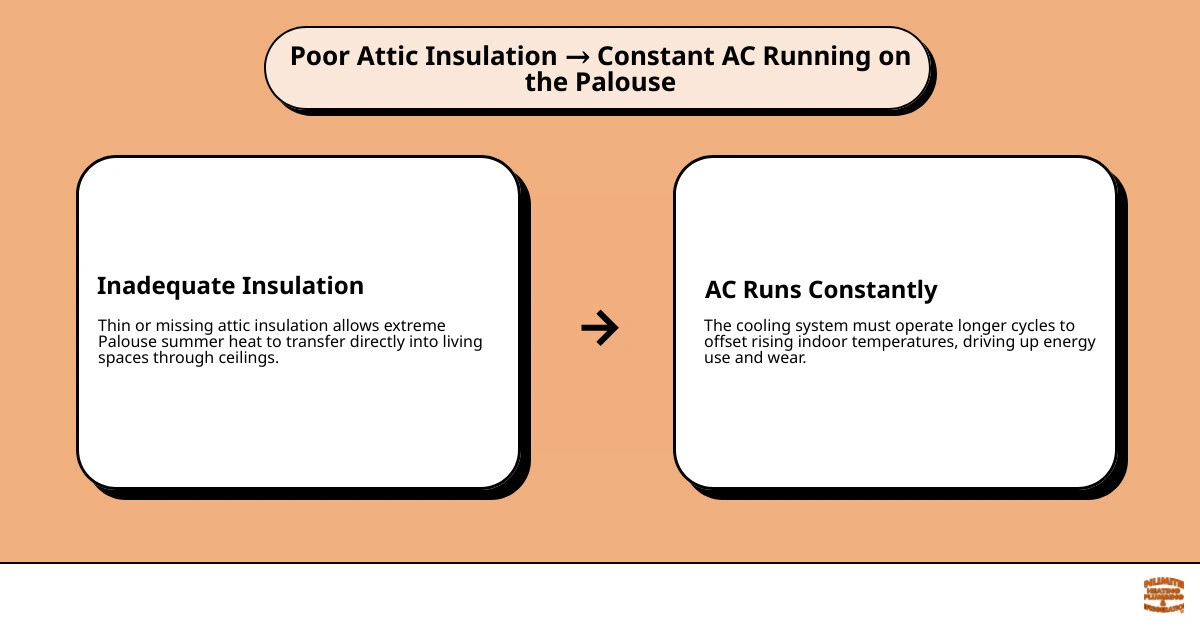
How poor attic insulation makes AC run constantly on the Palouse is one of the most overlooked causes of sky-high summer energy bills in the region. When attic insulation is thin, damaged, or missing, heat from the summer sun pours through your ceiling and into your living space — and your air conditioner never gets a break trying to keep up.
Here is a quick answer to why this happens:
- Heat pours in from above. Palouse attics can reach extreme temperatures on hot summer days. Without adequate insulation, that heat transfers directly into your home.
- Your AC fights a losing battle. The system runs longer and longer cycles trying to hit the thermostat setpoint — but the heat keeps coming in faster than it can be removed.
- Cooling efficiency drops. The more heat that enters your living space, the harder your AC works, the more energy it uses, and the sooner the system wears out.
- Energy bills climb. Continuous AC operation drives up electricity consumption, often significantly more than homeowners expect.
The good news: upgrading attic insulation is one of the most effective fixes available, and Avista utility programs have helped Washington-side Palouse homeowners access insulation upgrades with strong verified savings results.
How poor attic insulation makes ac run constantly on the palouse terms explained:
- ac running constantly in palouse summer heat
- how hot dry palouse summers make your ac work harder than coastal climates
How Poor Attic Insulation Makes AC Run Constantly on the Palouse
When the July heat hits Moscow, Idaho, or Pullman, Washington, your roof absorbs an incredible amount of solar radiation. On a typical 90°F day, the temperature inside an unventilated or poorly insulated attic can easily soar past 130°F. Without a proper thermal barrier, your home becomes a giant heat sponge, forcing your air conditioner into overdrive.
Thermal Dynamics: How Poor Attic Insulation Makes AC Run Constantly on the Palouse
To understand why your cooling system is struggling, it helps to understand the basic thermal dynamics of heat transfer. Heat naturally moves from warmer areas to cooler areas. In the summer, the blistering heat trapped in your attic wants nothing more than to move down into your air-conditioned living spaces.
Your insulation's R-value measures its resistance to this heat flow. The higher the R-value, the better the material is at stopping heat transfer. When attic insulation is degraded, settled, or simply too thin, its R-value drops. This allows radiant heat from the roof to warm up your ceiling drywall. Your ceiling then acts like a giant radiator, constantly beaming heat down onto your family.
This dynamic is particularly brutal here because of our climate. To learn more about these specific environmental demands, read our guide on How the Palouse Climate Creates Unique Demands on Your HVAC System. Additionally, our hot, dry summer days place a much higher sensible heat load on local homes than you would find in damp coastal cities. You can explore this further in our article on How Hot Dry Palouse Summers Make Your AC Work Harder Than Coastal Climates.

Identifying the Signs: How Poor Attic Insulation Makes AC Run Constantly on the Palouse
How do you know if your attic insulation is the primary culprit behind your overworked cooling system? Keep an eye out for these classic warning signs:
- Uneven Temperatures: The second floor of your home is significantly warmer than the main floor or basement.
- Hot Ceilings: If you touch your ceiling on a hot afternoon and it feels warm to the touch, heat is actively radiating through your drywall.
- Constant Cycling and Long Run Times: Your AC turns on and simply refuses to shut off, even after the sun goes down.
- High Utility Bills: Your summer energy bills are spiking compared to previous years.
If your system is running constantly but your home still feels warm, it is crucial to diagnose the issue quickly. You can check out our troubleshooting tips on AC Not Cooling But Running What to Check First to rule out other common mechanical issues. If the mechanical components are fine, you are almost certainly looking at a thermal boundary problem in your attic.
Avista’s Residential Shell and Home Insulation Programs
For homeowners on the Washington side of the Palouse, such as in Pullman, Colfax, or Garfield, Avista Utilities offers robust energy efficiency programs designed to help offset the burden of upgrading your home's thermal shell. These programs make it much easier to tackle poor attic insulation and stop your AC from running continuously.
Program Performance, Realization Rates, and 2025 Savings
Avista's residential energy efficiency initiatives have achieved remarkable success. In 2025, the Residential Shell Program far exceeded its targets, driven largely by homeowners upgrading their attic, floor, and wall insulation, alongside energy-efficient windows and doors.
Here is a look at the program's verified impact and performance metrics from 2025:
| Metric | Electric Savings / Incentives | Natural Gas Savings / Incentives |
|---|---|---|
| Annual Savings Achieved | 790,753 kWh (1,384% of goal) | 191,253 therms (300% of goal) |
| Total Program Incentives Paid | $1,169,902 | $5,918,152 |
| Verified Realization Rate | 76.24% | 85.06% |
These high realization rates—which measure the percentage of predicted energy savings that were actually verified during post-installation evaluations—demonstrate that attic insulation is a highly reliable way to lower energy consumption. The slight differences in realization rates (76.24% for electric and 85.06% for natural gas) are attributed to the use of more granular Regional Technical Forum (RTF) inputs. These inputs account for precise pre-existing R-values and specific local heating zones to ensure the savings calculations are as accurate as possible.
Addressing Equity and Access in Named Communities
Historically, high upfront costs have been a major barrier preventing homeowners from investing in insulation upgrades. To address this, Avista has made equity and access a core focus of its programs, particularly within "Named Communities" (areas designated as highly impacted or vulnerable under clean energy legislation).
In 2025, 72% of all electric incentives and 62% of all electric savings from Avista’s programs directly benefited these Named Communities. By focusing weatherization and residential shell programs on these areas, Avista helps ensure that those who stand to benefit the most from reduced utility bills and improved home comfort can access these vital upgrades.
Step-by-Step Guide to Upgrading Your Attic Insulation
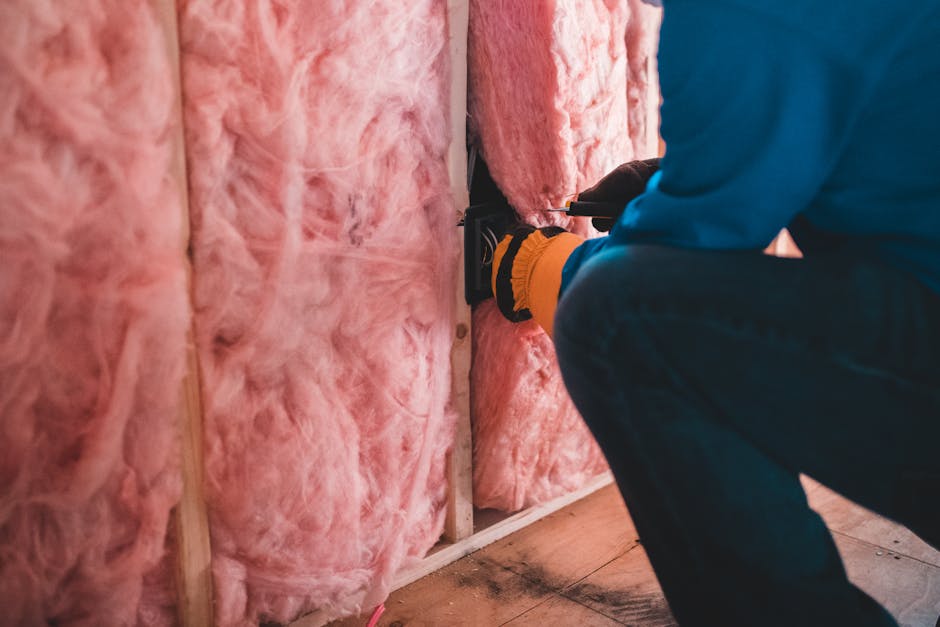
Ready to stop the heat and give your air conditioner a well-deserved break? Upgrading your attic insulation is a straightforward process, especially with utility support.
Accessing Avista Incentives and the Direct-Install Model
To improve program oversight, reduce upfront financial burdens, and support equitable access, Avista transitioned its Residential Shell Program to a direct-install model for insulation in 2025. Under this model, instead of paying the full cost of the installation upfront and waiting weeks for a rebate check, the incentive is applied directly to the project.
Here is how you can take advantage of these opportunities:
- Schedule an Energy Assessment: Contact an approved program representative or a qualified HVAC professional to assess your current attic insulation levels and identify air leaks.
- Review the Scope of Work: The technician will determine your current R-value and calculate the necessary material needed to bring your attic up to current energy codes (typically R-49 or R-60 for our region).
- Utilize the Direct-Install Program: By working with a participating contractor, Avista's substantial incentives are deducted directly from the service invoice, drastically reducing your out-of-pocket expenses.
- Enjoy Consistent Cooling: Once the insulation is blown in and air sealing is completed, your attic will finally block the summer heat, allowing your AC to cycle normally.
Maximizing Comfort, Health, and Non-Energy Benefits
While saving money on your monthly utility bill is fantastic, the "non-energy benefits" of upgrading your insulation are often just as valuable to Palouse families.
- Consistent Indoor Temperatures: No more stifling hot second floors or drafty winter corners.
- Quieter Indoor Environment: Quality insulation acts as an excellent sound barrier, dampening outdoor noise.
- Better Indoor Air Quality: A critical step in any insulation upgrade is "air sealing"—using foam and caulk to seal the gaps around light fixtures, pipes, and chimneys. This stops dusty, dirty attic air from being pulled down into your home.
This air sealing is especially important on the Palouse, where agricultural dust from local wheat fields is a constant presence. Keeping this fine dust out of your living space and your ductwork protects both your lungs and your cooling equipment. To learn more about how our local agricultural environment impacts your home, read about Why Agricultural Dust From Palouse Wheat Fields Impacts HVAC Performance Year-Round. Additionally, protecting your outdoor condenser from these elements is vital; learn how in our article on How Maintenance Extends AC Life in a Hot Dry Inland Climate.
Frequently Asked Questions about Attic Insulation and AC Performance
How do I know if my attic insulation is insufficient?
You can perform a quick visual inspection of your attic. If you look across your attic floor and can easily see the wooden floor joists (the wooden beams), your insulation is too thin. In our cold-winter, hot-summer climate, insulation should completely cover the joists and be at least 15 to 19 inches deep (equivalent to R-49 or R-60). If the insulation is level with or below the joists, your home is losing significant energy.
What are the realization rates for Avista's insulation programs?
In 2025, the verified realization rates for Avista’s Residential Shell Program were 76.24% for electric savings and 85.06% for natural gas savings. These high rates prove that attic insulation upgrades deliver highly predictable, real-world utility bill savings for local residents.
How does agricultural dust affect my AC alongside poor insulation?
On the Palouse, agricultural dust and poor insulation create a double-whammy for your cooling system. While poor insulation forces your AC to run constantly, airborne dust from nearby wheat fields settles on your outdoor condenser coils and indoor evaporator coils. This dust layer acts as an insulator on the coils, preventing them from releasing heat.
The combination of an extreme heat load from the attic and clogged, dirty coils can quickly cause your system to overheat, drop in efficiency, or suffer a major breakdown. You can read more about this specific local challenge in Why Agricultural Dust From the Palouse Clogs AC Coils Faster Than Average and How Agricultural Dust Damages AC Condenser Coils in Northern Idaho.
Conclusion
If your air conditioner is running constantly and struggling to keep your home cool during our dry Palouse summers, the root of the problem is likely hiding right above your head. Upgrading your attic insulation is one of the smartest, most cost-effective home improvements you can make to restore indoor comfort, lower your monthly energy bills, and protect your cooling system from premature wear and tear.
At Unlimited Heating & Refrigeration Inc, we have been serving our neighbors across the Palouse—from Moscow and Lewiston to Pullman and Colfax—for over 20 years. As a family-owned business and a trusted Daikin dealer, we stand behind our work with a 12-year warranty and our Comfort Promise.
Whether you need to schedule seasonal maintenance, repair an overworked system, or explore a full system upgrade, we are here to help. Contact us today to learn more about our comprehensive Air Conditioning and HVAC services.
Why Poor Attic Insulation Makes Your AC Run Constantly on the Palouse
How poor attic insulation makes AC run constantly on the Palouse is one of the most overlooked causes of sky-high summer energy bills in the region. When attic insulation is thin, damaged, or missing, heat from the summer sun pours through your ceiling and into your living space — and your air conditioner never gets a break trying to keep up.
Here is a quick answer to why this happens:
- Heat pours in from above. Palouse attics can reach extreme temperatures on hot summer days. Without adequate insulation, that heat transfers directly into your home.
- Your AC fights a losing battle. The system runs longer and longer cycles trying to hit the thermostat setpoint — but the heat keeps coming in faster than it can be removed.
- Cooling efficiency drops. The more heat that enters your living space, the harder your AC works, the more energy it uses, and the sooner the system wears out.
- Energy bills climb. Continuous AC operation drives up electricity consumption, often significantly more than homeowners expect.
The good news: upgrading attic insulation is one of the most effective fixes available, and Avista utility programs have helped Washington-side Palouse homeowners access insulation upgrades with strong verified savings results.

How poor attic insulation makes ac run constantly on the palouse terms explained:
- ac running constantly in palouse summer heat
- how hot dry palouse summers make your ac work harder than coastal climates
How Poor Attic Insulation Makes AC Run Constantly on the Palouse
When the July heat hits Moscow, Idaho, or Pullman, Washington, your roof absorbs an incredible amount of solar radiation. On a typical 90°F day, the temperature inside an unventilated or poorly insulated attic can easily soar past 130°F. Without a proper thermal barrier, your home becomes a giant heat sponge, forcing your air conditioner into overdrive.
Thermal Dynamics: How Poor Attic Insulation Makes AC Run Constantly on the Palouse
To understand why your cooling system is struggling, it helps to understand the basic thermal dynamics of heat transfer. Heat naturally moves from warmer areas to cooler areas. In the summer, the blistering heat trapped in your attic wants nothing more than to move down into your air-conditioned living spaces.
Your insulation's R-value measures its resistance to this heat flow. The higher the R-value, the better the material is at stopping heat transfer. When attic insulation is degraded, settled, or simply too thin, its R-value drops. This allows radiant heat from the roof to warm up your ceiling drywall. Your ceiling then acts like a giant radiator, constantly beaming heat down onto your family.
This dynamic is particularly brutal here because of our climate. To learn more about these specific environmental demands, read our guide on How the Palouse Climate Creates Unique Demands on Your HVAC System. Additionally, our hot, dry summer days place a much higher sensible heat load on local homes than you would find in damp coastal cities. You can explore this further in our article on How Hot Dry Palouse Summers Make Your AC Work Harder Than Coastal Climates.

Identifying the Signs: How Poor Attic Insulation Makes AC Run Constantly on the Palouse
How do you know if your attic insulation is the primary culprit behind your overworked cooling system? Keep an eye out for these classic warning signs:
- Uneven Temperatures: The second floor of your home is significantly warmer than the main floor or basement.
- Hot Ceilings: If you touch your ceiling on a hot afternoon and it feels warm to the touch, heat is actively radiating through your drywall.
- Constant Cycling and Long Run Times: Your AC turns on and simply refuses to shut off, even after the sun goes down.
- High Utility Bills: Your summer energy bills are spiking compared to previous years.
If your system is running constantly but your home still feels warm, it is crucial to diagnose the issue quickly. You can check out our troubleshooting tips on AC Not Cooling But Running What to Check First to rule out other common mechanical issues. If the mechanical components are fine, you are almost certainly looking at a thermal boundary problem in your attic.
Avista’s Residential Shell and Home Insulation Programs
For homeowners on the Washington side of the Palouse, such as in Pullman, Colfax, or Garfield, Avista Utilities offers robust energy efficiency programs designed to help offset the burden of upgrading your home's thermal shell. These programs make it much easier to tackle poor attic insulation and stop your AC from running continuously.
Program Performance, Realization Rates, and 2025 Savings
Avista's residential energy efficiency initiatives have achieved remarkable success. In 2025, the Residential Shell Program far exceeded its targets, driven largely by homeowners upgrading their attic, floor, and wall insulation, alongside energy-efficient windows and doors.
Here is a look at the program's verified impact and performance metrics from 2025:
| Metric | Electric Savings / Incentives | Natural Gas Savings / Incentives |
|---|---|---|
| Annual Savings Achieved | 790,753 kWh (1,384% of goal) | 191,253 therms (300% of goal) |
| Total Program Incentives Paid | $1,169,902 | $5,918,152 |
| Verified Realization Rate | 76.24% | 85.06% |
These high realization rates—which measure the percentage of predicted energy savings that were actually verified during post-installation evaluations—demonstrate that attic insulation is a highly reliable way to lower energy consumption. The slight differences in realization rates (76.24% for electric and 85.06% for natural gas) are attributed to the use of more granular Regional Technical Forum (RTF) inputs. These inputs account for precise pre-existing R-values and specific local heating zones to ensure the savings calculations are as accurate as possible.
Addressing Equity and Access in Named Communities
Historically, high upfront costs have been a major barrier preventing homeowners from investing in insulation upgrades. To address this, Avista has made equity and access a core focus of its programs, particularly within "Named Communities" (areas designated as highly impacted or vulnerable under clean energy legislation).
In 2025, 72% of all electric incentives and 62% of all electric savings from Avista’s programs directly benefited these Named Communities. By focusing weatherization and residential shell programs on these areas, Avista helps ensure that those who stand to benefit the most from reduced utility bills and improved home comfort can access these vital upgrades.
Step-by-Step Guide to Upgrading Your Attic Insulation
Ready to stop the heat and give your air conditioner a well-deserved break? Upgrading your attic insulation is a straightforward process, especially with utility support.

Accessing Avista Incentives and the Direct-Install Model
To improve program oversight, reduce upfront financial burdens, and support equitable access, Avista transitioned its Residential Shell Program to a direct-install model for insulation in 2025. Under this model, instead of paying the full cost of the installation upfront and waiting weeks for a rebate check, the incentive is applied directly to the project.
Here is how you can take advantage of these opportunities:
- Schedule an Energy Assessment: Contact an approved program representative or a qualified HVAC professional to assess your current attic insulation levels and identify air leaks.
- Review the Scope of Work: The technician will determine your current R-value and calculate the necessary material needed to bring your attic up to current energy codes (typically R-49 or R-60 for our region).
- Utilize the Direct-Install Program: By working with a participating contractor, Avista's substantial incentives are deducted directly from the service invoice, drastically reducing your out-of-pocket expenses.
- Enjoy Consistent Cooling: Once the insulation is blown in and air sealing is completed, your attic will finally block the summer heat, allowing your AC to cycle normally.
Maximizing Comfort, Health, and Non-Energy Benefits
While saving money on your monthly utility bill is fantastic, the "non-energy benefits" of upgrading your insulation are often just as valuable to Palouse families.
- Consistent Indoor Temperatures: No more stifling hot second floors or drafty winter corners.
- Quieter Indoor Environment: Quality insulation acts as an excellent sound barrier, dampening outdoor noise.
- Better Indoor Air Quality: A critical step in any insulation upgrade is "air sealing"—using foam and caulk to seal the gaps around light fixtures, pipes, and chimneys. This stops dusty, dirty attic air from being pulled down into your home.
This air sealing is especially important on the Palouse, where agricultural dust from local wheat fields is a constant presence. Keeping this fine dust out of your living space and your ductwork protects both your lungs and your cooling equipment. To learn more about how our local agricultural environment impacts your home, read about Why Agricultural Dust From Palouse Wheat Fields Impacts HVAC Performance Year-Round. Additionally, protecting your outdoor condenser from these elements is vital; learn how in our article on How Maintenance Extends AC Life in a Hot Dry Inland Climate.
Frequently Asked Questions about Attic Insulation and AC Performance
How do I know if my attic insulation is insufficient?
You can perform a quick visual inspection of your attic. If you look across your attic floor and can easily see the wooden floor joists (the wooden beams), your insulation is too thin. In our cold-winter, hot-summer climate, insulation should completely cover the joists and be at least 15 to 19 inches deep (equivalent to R-49 or R-60). If the insulation is level with or below the joists, your home is losing significant energy.
What are the realization rates for Avista's insulation programs?
In 2025, the verified realization rates for Avista’s Residential Shell Program were 76.24% for electric savings and 85.06% for natural gas savings. These high rates prove that attic insulation upgrades deliver highly predictable, real-world utility bill savings for local residents.
How does agricultural dust affect my AC alongside poor insulation?
On the Palouse, agricultural dust and poor insulation create a double-whammy for your cooling system. While poor insulation forces your AC to run constantly, airborne dust from nearby wheat fields settles on your outdoor condenser coils and indoor evaporator coils. This dust layer acts as an insulator on the coils, preventing them from releasing heat.
The combination of an extreme heat load from the attic and clogged, dirty coils can quickly cause your system to overheat, drop in efficiency, or suffer a major breakdown. You can read more about this specific local challenge in Why Agricultural Dust From the Palouse Clogs AC Coils Faster Than Average and How Agricultural Dust Damages AC Condenser Coils in Northern Idaho.
Conclusion
If your air conditioner is running constantly and struggling to keep your home cool during our dry Palouse summers, the root of the problem is likely hiding right above your head. Upgrading your attic insulation is one of the smartest, most cost-effective home improvements you can make to restore indoor comfort, lower your monthly energy bills, and protect your cooling system from premature wear and tear.
At Unlimited Heating & Refrigeration Inc, we have been serving our neighbors across the Palouse—from Moscow and Lewiston to Pullman and Colfax—for over 20 years. As a family-owned business and a trusted Daikin dealer, we stand behind our work with a 12-year warranty and our Comfort Promise.
Whether you need to schedule seasonal maintenance, repair an overworked system, or explore a full system upgrade, we are here to help. Contact us today to learn more about our comprehensive Air Conditioning and HVAC services.
Customer Testimonials
Our customers love our service and support.


