HomeNext IconBlogNext Icon

A Practical Guide to Avista Federal HVAC Rebates in ID & WA

Design Element | Unlimited Heating Plumbing & Refrigeration Inc

How Avista and Federal Rebates for HVAC in Idaho and Washington Work in 2026

If you're trying to understand avista and federal rebates for HVAC in Idaho and Washington, here's the quick answer:

  • Avista utility rebates are available in both Idaho and Washington for qualifying heat pumps, condensing gas furnaces, mini-splits, and water heaters
  • Federal tax credits under Section 25C expired December 31, 2025, and are no longer available in 2026
  • Idaho rejected $24.6 million in federal HEAR and HOMES rebate funding, so no state-administered federal programs exist there
  • Washington customers have access to Avista rebates but should verify current state-level program availability
  • Avista uses a midstream rebate model in Idaho, meaning discounts are applied directly on the contractor invoice at the time of purchase
  • Rebate submissions must be made within 120 days of project completion in both states

Homeowners in Idaho and Washington who heat with electricity know the stakes are high. Residential space heating accounts for roughly 27–28% of annual electricity use across Avista's service territory — and that share jumps to nearly 40–45% of winter peak demand. With energy use projected to grow significantly over the next two decades, the pressure to upgrade aging, inefficient HVAC systems is real.

The challenge is knowing exactly what financial help is still on the table. The incentive landscape shifted considerably after 2025. Federal programs that many homeowners were counting on have expired or were never activated in Idaho. What remains is a patchwork of utility rebates, state loan programs, and equipment-specific incentives that vary depending on which side of the state line you live on.

This guide cuts through the confusion so you know precisely what's available, what you qualify for, and how to claim every dollar you're entitled to.
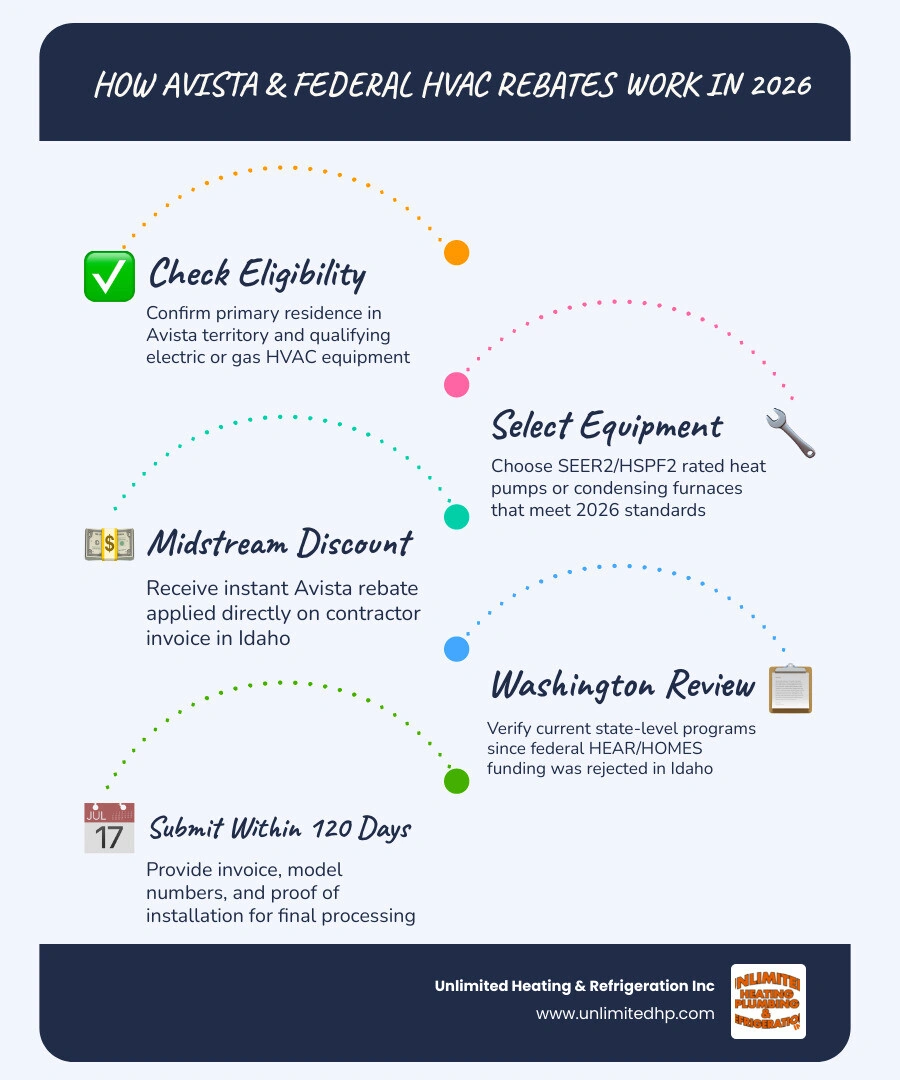
Infographic showing how Avista utility rebates and federal incentives stack for HVAC upgrades in Idaho and Washington 2026

Quick avista and federal rebates for hvac in idaho and washington definitions:

Understanding Avista and Federal Rebates for HVAC in Idaho and Washington
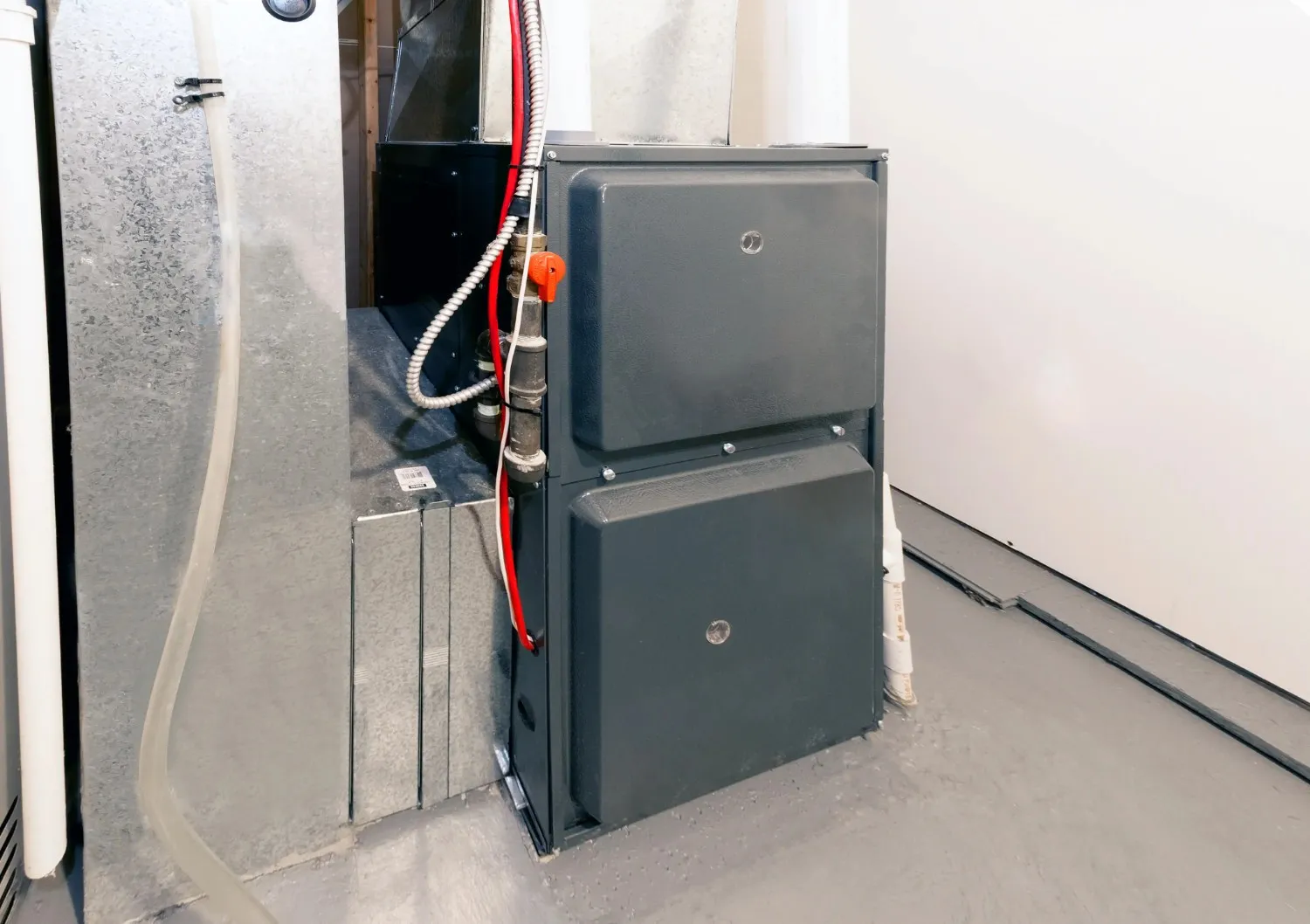
modern HVAC system in a residential home

Navigating the energy landscape in the Inland Northwest requires understanding how our local utility, Avista, operates across state lines. Avista serves a massive base of residential households in our region. In Washington, the utility serves 234,506 residential households, consuming 2,671 GWh of electricity annually. In Idaho, they power 120,131 households, using 1,320 GWh per year.

Because space heating is a massive driver of this energy consumption, both states face distinct challenges. In Washington, residential space heating accounts for 28% of annual electricity use and a staggering 45% of winter peak demand. In Idaho, space heating represents 27% of annual electricity use and 39% of winter peak demand.

To manage this strain on the grid, Avista heavily promotes energy efficiency. This is particularly crucial because residential baseline electricity use is projected to grow rapidly over the coming decades. Washington’s baseline residential use is projected to grow 37.4% by 2045, while Idaho’s is expected to rise by 33.6%.

To curb this growth, incentivizing homeowners to transition from older electric resistance heating or aging systems to high-efficiency heat pumps is a top priority. When analyzing the Heat Pump vs Traditional HVAC for Home debate, modern heat pumps emerge as the clear winner for reducing peak demand and lowering seasonal energy bills.

To help local homeowners make the transition, utility rebate programs are designed to lower the upfront barrier of these upgrades. You can read more about how these local programs have evolved in our guide to Avista Rebates for Heat Pump Installation in Idaho and Washington 2025.

Federal Tax Credits and IRA Programs: What is Available in 2026?

As we navigate the landscape of July 2026, many homeowners are asking what happened to the federal tax credits and programs established under the Inflation Reduction Act (IRA).

Historically, the Section 25C federal tax credit provided significant relief for installing energy-efficient heat pumps, central air conditioning, and qualifying natural gas furnaces. However, due to legislative changes—specifically the One Big Beautiful Bill Act—these federal tax credits officially expired on December 31, 2025. This means that for installations completed in 2026, the 25C federal tax credit is no longer an option to reduce your tax liability. For historical context on how this program used to work, you can review our article on What is the 25C Tax Credit for HVAC Equipment in Idaho.

Additionally, the federal Home Energy Appliance Rebates (HEAR) and Home Owner Managing Energy Savings (HOMES) programs, which were designed to provide point-of-sale discounts for high-efficiency upgrades, have experienced highly fractured rollouts. While some states have active programs, the availability of these federal funds depends entirely on state-level administration, which looks radically different depending on whether you live in Idaho or Washington.

State-Specific Differences: Idaho vs. Washington Policies

The geographical boundary between Idaho and Washington creates a major divergence in how federal and state energy policies affect your HVAC options.

In March 2025, the state of Idaho officially rejected $24.6 million in federal funding allocated for the HEAR and HOMES rebate programs. Because the state declined to participate, there are no state-administered federal IRA rebates available for Idaho homeowners in 2026. If you live in communities like Moscow, Lewiston, or Genesee, your incentive options are limited to Avista’s utility rebates and state-specific financing options.

In contrast, Washington state has fully embraced electrification and energy efficiency policies. The Washington State Energy Code assumes that more than 90% of new residential construction will utilize all-electric heat pump systems for space heating. Furthermore, Washington continues to explore state-level programs to support clean energy transitions.

Because building codes and local regulations differ so sharply across the state line, ensuring your installation is fully compliant is essential. Before beginning any major project in areas like Clarkston, WA, or Lewiston, ID, it is highly recommended to consult our AC Replacement Permit Guide Idaho Washington to understand the necessary permitting and inspection steps.

Avista HVAC Rebate Amounts and Covered Equipment

Despite the expiration of federal tax credits, Avista continues to offer robust utility rebates to help offset the cost of high-efficiency HVAC installations. These programs target the equipment that has the greatest impact on reducing energy consumption and peak grid demand.

Covered equipment categories include:

  • Ducted Air-Source Heat Pumps: These systems replace or supplement existing heating systems, offering highly efficient heating and cooling.
  • Ductless Mini-Split Heat Pumps: Perfect for homes without existing ductwork, providing zoned comfort.
  • Condensing Gas Furnaces: High-efficiency gas heating units that maximize fuel utilization.
  • Smart Thermostats: Direct controls that optimize heating and cooling schedules to prevent energy waste.

If your current system is struggling, keeping up with maintenance or knowing when to upgrade is key. Homeowners can look out for Signs You Need Heat Pump Repair Lewiston Home to determine if a fix will suffice, or read our guide on When to Upgrade Home Heat Pump Lewiston to see if replacing the unit is the more financially sound decision.

To give you a clear picture of what Avista offers, we have compiled the standard residential rebate structures below.

Equipment TypeWashington IncentiveIdaho IncentiveMinimum Efficiency / Program Requirements
Tier 3 Air-Source Heat Pump$600$600Must meet SEER2 and HSPF2 efficiency tiers
Tier 1 Mini-Split (New Construction)$400$180Zonal heating efficiency standards
Condensing Gas Furnace$650$350Must be $\ge$ 90% AFUE
Condensing Gas Boiler$550$550$\ge$ 90% AFUE units
Heat Pump Water Heater (Retrofit)$500$500Hybrid heat pump water heater under 120 gallons
Tankless Gas Water Heater$475$100High-efficiency gas units
Smart ThermostatUp to $40Up to $40Qualifying programmable/smart models

Qualifying Equipment and Efficiency Standards for Avista and Federal Rebates for HVAC in Idaho and Washington

To protect the integrity of its programs, Avista enforces strict efficiency standards. It is no longer enough for a system to simply be "new."

As of March 1, 2025, Avista transitioned fully to the newer testing standards. Equipment rated under the old SEER and HSPF metrics is no longer eligible for rebates. All new installations must be rated under the SEER2 (Seasonal Energy Efficiency Ratio 2) and HSPF2 (Heating Seasonal Performance Factor 2) protocols.

  • Air-Source Heat Pumps: Must meet specific SEER2 and HSPF2 tiers. For example, Tier 3 systems qualify for the maximum $600 utility rebate in both states.
  • Gas Furnaces and Boilers: Must feature an Annual Fuel Utilization Efficiency (AFUE) rating of 90% or higher.
  • Water Heaters: Heat pump water heaters must be hybrid models under 120 gallons. This is a critical category because a new federal heat pump water heater standard, set to take effect in 2029, will eventually make heat pump water heaters the baseline equipment for residential homes. Upgrading early allows you to take advantage of the current retrofit incentives.

Additionally, residential incentives are strictly capped at two units per customer for heat pumps, furnaces, water heaters, and boilers.

Eligibility and the Application Process for Avista Incentives

Before planning an installation, it is vital to verify that your property and account meet Avista’s strict eligibility guidelines.

To qualify for residential rebates, the property must be a primary residence. Seasonal or recreational homes, as well as condominiums, are generally excluded from standard single-family residential rebates. Eligible property types include:

  • Single-family homes
  • Duplexes, triplexes, and fourplexes
  • Manufactured and modular homes on permanent foundations

For larger residential buildings, Avista offers Washington Multifamily Rebates for properties with five or more units, which can utilize prescriptive or site-specific rebate paths.

Another critical requirement is that the home must use Avista as its primary utility provider for the fuel source being upgraded. To qualify for electric heating rebates, your primary heating fuel must be Avista electricity, with an annual usage threshold of at least 4,000 kWh. For natural gas rebates, you must have active Avista natural gas service with a minimum annual usage of 120 therms.

When faced with a failing system, understanding these eligibility rules is a core part of deciding whether to invest in ongoing maintenance or move forward with a complete system replacement. You can learn more about this financial equation by reading How Avista Rebates Factor into the AC Repair vs Replace Decision.

How to Apply for Avista and Federal Rebates for HVAC in Idaho and Washington

The application process differs depending on whether you are installing equipment in Washington or Idaho, and whether the rebate is administered "midstream" or "downstream."

In Idaho, Avista utilizes a midstream rebate program for many of its residential HVAC incentives. This is designed to be as seamless as possible for the homeowner. Instead of filling out paperwork and waiting months for a check, the rebate is applied directly as a discount on your contractor’s invoice at the time of purchase. The installing contractor must be enrolled in Avista’s network, and they are required to show the rebate as a clear, dedicated line item on your final bill.

For traditional downstream rebates (such as those for weatherization, windows, or certain water heating units), the submission process is as follows:

  1. Complete the Installation: Ensure the work is performed by a licensed contractor to qualify for the highest incentive tiers.
  2. Gather Documentation: You will need legible copies of the final, itemized invoice showing the equipment model numbers, serial numbers, and proof of payment. For window installations, U-factor documentation and photos are required.
  3. Submit Within 120 Days: All rebate forms must be submitted to Avista within 120 days of project completion. Late submissions are routinely denied.
  4. Processing: Once submitted, Avista typically processes the application and issues a check or account credit within 8 weeks.

For business owners in our region, commercial spaces have different submission requirements and custom energy-saving incentives. If you operate a commercial property, check out our guide on Heat Pump Replacement Lewiston Commercial Spaces to explore tailored commercial HVAC solutions.

Frequently Asked Questions about Avista and Federal HVAC Rebates

Can I stack Avista utility rebates with federal tax credits in 2026?

No. Because the federal Section 25C tax credits expired on December 31, 2025, there are no active federal tax credits to stack with Avista utility rebates in 2026. Furthermore, because Idaho rejected the federal HEAR and HOMES funding, Idaho homeowners cannot stack federal grant rebates with their Avista incentives. Your primary financial incentives in 2026 will come directly through Avista's utility programs and state-level financing.

What is the difference between midstream and downstream rebates?

A midstream rebate is applied at the distributor or contractor level. The contractor receives the incentive directly and passes 100% of the savings on to you as an immediate discount on your invoice. A downstream rebate requires you, the homeowner, to pay the full retail cost of the installation upfront, collect all invoices and efficiency certificates, and submit a formal application to Avista to receive a rebate check or utility account credit weeks later.

Does Idaho offer any state-level financing for HVAC upgrades?

Yes. While Idaho does not offer direct state-level cash rebates, the Idaho Governor’s Office of Energy and Mineral Resources (OEMR) administers the State Energy Loan Program. This program provides low-interest loans ranging from $1,000 to $30,000 with attractive interest rates (typically 3% to 7%) to help homeowners finance energy-efficient upgrades, including qualifying heat pumps and weatherization projects.

Conclusion

Navigating the changing landscape of energy incentives in 2026 doesn't have to be overwhelming. While federal tax credits have expired and state policies remain distinct between Idaho and Washington, Avista’s local utility rebates continue to provide reliable, direct pathways to lower the cost of high-efficiency HVAC systems.

At Unlimited Heating & Refrigeration Inc, we are proud to serve communities across the Palouse and the LC Valley—including Moscow, Lewiston, Clarkston, Pullman, Troy, and Genesee. As a family-owned business with over 20 years of experience, we are dedicated to helping our neighbors find the most efficient comfort solutions for their homes. As a trusted Daikin dealer, we back our installations with a 12-year warranty and our signature Comfort Promise.

If you are ready to upgrade your heating and cooling system and want to maximize your utility rebates, we are here to help.

Upgrade your home comfort with Unlimited Heating & Refrigeration Inc

How Avista and Federal Rebates for HVAC in Idaho and Washington Work in 2026

If you're trying to understand avista and federal rebates for HVAC in Idaho and Washington, here's the quick answer:

  • Avista utility rebates are available in both Idaho and Washington for qualifying heat pumps, condensing gas furnaces, mini-splits, and water heaters
  • Federal tax credits under Section 25C expired December 31, 2025, and are no longer available in 2026
  • Idaho rejected $24.6 million in federal HEAR and HOMES rebate funding, so no state-administered federal programs exist there
  • Washington customers have access to Avista rebates but should verify current state-level program availability
  • Avista uses a midstream rebate model in Idaho, meaning discounts are applied directly on the contractor invoice at the time of purchase
  • Rebate submissions must be made within 120 days of project completion in both states

Homeowners in Idaho and Washington who heat with electricity know the stakes are high. Residential space heating accounts for roughly 27–28% of annual electricity use across Avista's service territory — and that share jumps to nearly 40–45% of winter peak demand. With energy use projected to grow significantly over the next two decades, the pressure to upgrade aging, inefficient HVAC systems is real.

The challenge is knowing exactly what financial help is still on the table. The incentive landscape shifted considerably after 2025. Federal programs that many homeowners were counting on have expired or were never activated in Idaho. What remains is a patchwork of utility rebates, state loan programs, and equipment-specific incentives that vary depending on which side of the state line you live on.

This guide cuts through the confusion so you know precisely what's available, what you qualify for, and how to claim every dollar you're entitled to.

Infographic showing how Avista utility rebates and federal incentives stack for HVAC upgrades in Idaho and Washington 2026

Quick avista and federal rebates for hvac in idaho and washington definitions:

Understanding Avista and Federal Rebates for HVAC in Idaho and Washington

modern HVAC system in a residential home

Navigating the energy landscape in the Inland Northwest requires understanding how our local utility, Avista, operates across state lines. Avista serves a massive base of residential households in our region. In Washington, the utility serves 234,506 residential households, consuming 2,671 GWh of electricity annually. In Idaho, they power 120,131 households, using 1,320 GWh per year.

Because space heating is a massive driver of this energy consumption, both states face distinct challenges. In Washington, residential space heating accounts for 28% of annual electricity use and a staggering 45% of winter peak demand. In Idaho, space heating represents 27% of annual electricity use and 39% of winter peak demand.

To manage this strain on the grid, Avista heavily promotes energy efficiency. This is particularly crucial because residential baseline electricity use is projected to grow rapidly over the coming decades. Washington’s baseline residential use is projected to grow 37.4% by 2045, while Idaho’s is expected to rise by 33.6%.

To curb this growth, incentivizing homeowners to transition from older electric resistance heating or aging systems to high-efficiency heat pumps is a top priority. When analyzing the Heat Pump vs Traditional HVAC for Home debate, modern heat pumps emerge as the clear winner for reducing peak demand and lowering seasonal energy bills.

To help local homeowners make the transition, utility rebate programs are designed to lower the upfront barrier of these upgrades. You can read more about how these local programs have evolved in our guide to Avista Rebates for Heat Pump Installation in Idaho and Washington 2025.

Federal Tax Credits and IRA Programs: What is Available in 2026?

As we navigate the landscape of July 2026, many homeowners are asking what happened to the federal tax credits and programs established under the Inflation Reduction Act (IRA).

Historically, the Section 25C federal tax credit provided significant relief for installing energy-efficient heat pumps, central air conditioning, and qualifying natural gas furnaces. However, due to legislative changes—specifically the One Big Beautiful Bill Act—these federal tax credits officially expired on December 31, 2025. This means that for installations completed in 2026, the 25C federal tax credit is no longer an option to reduce your tax liability. For historical context on how this program used to work, you can review our article on What is the 25C Tax Credit for HVAC Equipment in Idaho.

Additionally, the federal Home Energy Appliance Rebates (HEAR) and Home Owner Managing Energy Savings (HOMES) programs, which were designed to provide point-of-sale discounts for high-efficiency upgrades, have experienced highly fractured rollouts. While some states have active programs, the availability of these federal funds depends entirely on state-level administration, which looks radically different depending on whether you live in Idaho or Washington.

State-Specific Differences: Idaho vs. Washington Policies

The geographical boundary between Idaho and Washington creates a major divergence in how federal and state energy policies affect your HVAC options.

In March 2025, the state of Idaho officially rejected $24.6 million in federal funding allocated for the HEAR and HOMES rebate programs. Because the state declined to participate, there are no state-administered federal IRA rebates available for Idaho homeowners in 2026. If you live in communities like Moscow, Lewiston, or Genesee, your incentive options are limited to Avista’s utility rebates and state-specific financing options.

In contrast, Washington state has fully embraced electrification and energy efficiency policies. The Washington State Energy Code assumes that more than 90% of new residential construction will utilize all-electric heat pump systems for space heating. Furthermore, Washington continues to explore state-level programs to support clean energy transitions.

Because building codes and local regulations differ so sharply across the state line, ensuring your installation is fully compliant is essential. Before beginning any major project in areas like Clarkston, WA, or Lewiston, ID, it is highly recommended to consult our AC Replacement Permit Guide Idaho Washington to understand the necessary permitting and inspection steps.

Avista HVAC Rebate Amounts and Covered Equipment

Despite the expiration of federal tax credits, Avista continues to offer robust utility rebates to help offset the cost of high-efficiency HVAC installations. These programs target the equipment that has the greatest impact on reducing energy consumption and peak grid demand.

Covered equipment categories include:

  • Ducted Air-Source Heat Pumps: These systems replace or supplement existing heating systems, offering highly efficient heating and cooling.
  • Ductless Mini-Split Heat Pumps: Perfect for homes without existing ductwork, providing zoned comfort.
  • Condensing Gas Furnaces: High-efficiency gas heating units that maximize fuel utilization.
  • Smart Thermostats: Direct controls that optimize heating and cooling schedules to prevent energy waste.

If your current system is struggling, keeping up with maintenance or knowing when to upgrade is key. Homeowners can look out for Signs You Need Heat Pump Repair Lewiston Home to determine if a fix will suffice, or read our guide on When to Upgrade Home Heat Pump Lewiston to see if replacing the unit is the more financially sound decision.

To give you a clear picture of what Avista offers, we have compiled the standard residential rebate structures below.

Equipment TypeWashington IncentiveIdaho IncentiveMinimum Efficiency / Program Requirements
Tier 3 Air-Source Heat Pump$600$600Must meet SEER2 and HSPF2 efficiency tiers
Tier 1 Mini-Split (New Construction)$400$180Zonal heating efficiency standards
Condensing Gas Furnace$650$350Must be $\ge$ 90% AFUE
Condensing Gas Boiler$550$550$\ge$ 90% AFUE units
Heat Pump Water Heater (Retrofit)$500$500Hybrid heat pump water heater under 120 gallons
Tankless Gas Water Heater$475$100High-efficiency gas units
Smart ThermostatUp to $40Up to $40Qualifying programmable/smart models

Qualifying Equipment and Efficiency Standards for Avista and Federal Rebates for HVAC in Idaho and Washington

To protect the integrity of its programs, Avista enforces strict efficiency standards. It is no longer enough for a system to simply be "new."

As of March 1, 2025, Avista transitioned fully to the newer testing standards. Equipment rated under the old SEER and HSPF metrics is no longer eligible for rebates. All new installations must be rated under the SEER2 (Seasonal Energy Efficiency Ratio 2) and HSPF2 (Heating Seasonal Performance Factor 2) protocols.

  • Air-Source Heat Pumps: Must meet specific SEER2 and HSPF2 tiers. For example, Tier 3 systems qualify for the maximum $600 utility rebate in both states.
  • Gas Furnaces and Boilers: Must feature an Annual Fuel Utilization Efficiency (AFUE) rating of 90% or higher.
  • Water Heaters: Heat pump water heaters must be hybrid models under 120 gallons. This is a critical category because a new federal heat pump water heater standard, set to take effect in 2029, will eventually make heat pump water heaters the baseline equipment for residential homes. Upgrading early allows you to take advantage of the current retrofit incentives.

Additionally, residential incentives are strictly capped at two units per customer for heat pumps, furnaces, water heaters, and boilers.

Eligibility and the Application Process for Avista Incentives

Before planning an installation, it is vital to verify that your property and account meet Avista’s strict eligibility guidelines.

To qualify for residential rebates, the property must be a primary residence. Seasonal or recreational homes, as well as condominiums, are generally excluded from standard single-family residential rebates. Eligible property types include:

  • Single-family homes
  • Duplexes, triplexes, and fourplexes
  • Manufactured and modular homes on permanent foundations

For larger residential buildings, Avista offers Washington Multifamily Rebates for properties with five or more units, which can utilize prescriptive or site-specific rebate paths.

Another critical requirement is that the home must use Avista as its primary utility provider for the fuel source being upgraded. To qualify for electric heating rebates, your primary heating fuel must be Avista electricity, with an annual usage threshold of at least 4,000 kWh. For natural gas rebates, you must have active Avista natural gas service with a minimum annual usage of 120 therms.

When faced with a failing system, understanding these eligibility rules is a core part of deciding whether to invest in ongoing maintenance or move forward with a complete system replacement. You can learn more about this financial equation by reading How Avista Rebates Factor into the AC Repair vs Replace Decision.

How to Apply for Avista and Federal Rebates for HVAC in Idaho and Washington

The application process differs depending on whether you are installing equipment in Washington or Idaho, and whether the rebate is administered "midstream" or "downstream."

In Idaho, Avista utilizes a midstream rebate program for many of its residential HVAC incentives. This is designed to be as seamless as possible for the homeowner. Instead of filling out paperwork and waiting months for a check, the rebate is applied directly as a discount on your contractor’s invoice at the time of purchase. The installing contractor must be enrolled in Avista’s network, and they are required to show the rebate as a clear, dedicated line item on your final bill.

For traditional downstream rebates (such as those for weatherization, windows, or certain water heating units), the submission process is as follows:

  1. Complete the Installation: Ensure the work is performed by a licensed contractor to qualify for the highest incentive tiers.
  2. Gather Documentation: You will need legible copies of the final, itemized invoice showing the equipment model numbers, serial numbers, and proof of payment. For window installations, U-factor documentation and photos are required.
  3. Submit Within 120 Days: All rebate forms must be submitted to Avista within 120 days of project completion. Late submissions are routinely denied.
  4. Processing: Once submitted, Avista typically processes the application and issues a check or account credit within 8 weeks.

For business owners in our region, commercial spaces have different submission requirements and custom energy-saving incentives. If you operate a commercial property, check out our guide on Heat Pump Replacement Lewiston Commercial Spaces to explore tailored commercial HVAC solutions.

Frequently Asked Questions about Avista and Federal HVAC Rebates

Can I stack Avista utility rebates with federal tax credits in 2026?

No. Because the federal Section 25C tax credits expired on December 31, 2025, there are no active federal tax credits to stack with Avista utility rebates in 2026. Furthermore, because Idaho rejected the federal HEAR and HOMES funding, Idaho homeowners cannot stack federal grant rebates with their Avista incentives. Your primary financial incentives in 2026 will come directly through Avista's utility programs and state-level financing.

What is the difference between midstream and downstream rebates?

A midstream rebate is applied at the distributor or contractor level. The contractor receives the incentive directly and passes 100% of the savings on to you as an immediate discount on your invoice. A downstream rebate requires you, the homeowner, to pay the full retail cost of the installation upfront, collect all invoices and efficiency certificates, and submit a formal application to Avista to receive a rebate check or utility account credit weeks later.

Does Idaho offer any state-level financing for HVAC upgrades?

Yes. While Idaho does not offer direct state-level cash rebates, the Idaho Governor’s Office of Energy and Mineral Resources (OEMR) administers the State Energy Loan Program. This program provides low-interest loans ranging from $1,000 to $30,000 with attractive interest rates (typically 3% to 7%) to help homeowners finance energy-efficient upgrades, including qualifying heat pumps and weatherization projects.

Conclusion

Navigating the changing landscape of energy incentives in 2026 doesn't have to be overwhelming. While federal tax credits have expired and state policies remain distinct between Idaho and Washington, Avista’s local utility rebates continue to provide reliable, direct pathways to lower the cost of high-efficiency HVAC systems.

At Unlimited Heating & Refrigeration Inc, we are proud to serve communities across the Palouse and the LC Valley—including Moscow, Lewiston, Clarkston, Pullman, Troy, and Genesee. As a family-owned business with over 20 years of experience, we are dedicated to helping our neighbors find the most efficient comfort solutions for their homes. As a trusted Daikin dealer, we back our installations with a 12-year warranty and our signature Comfort Promise.

If you are ready to upgrade your heating and cooling system and want to maximize your utility rebates, we are here to help.

Upgrade your home comfort with Unlimited Heating & Refrigeration Inc

Customer Testimonials

Our customers love our service and support.

Design Element | Unlimited Heating Plumbing & Refrigeration IncDesign Element | Unlimited Heating Plumbing & Refrigeration Inc