When Your AC Can't Keep Up: Undersized AC Unit Signs and Problems in a Hot Inland Climate
Undersized AC unit signs and problems in a hot inland climate are more common than most homeowners realize — and they often go unnoticed until the system is already failing. If your home never seems to cool down no matter how long the AC runs, or your energy bills keep climbing through summer, your unit may simply not be built for the heat load your home actually creates.
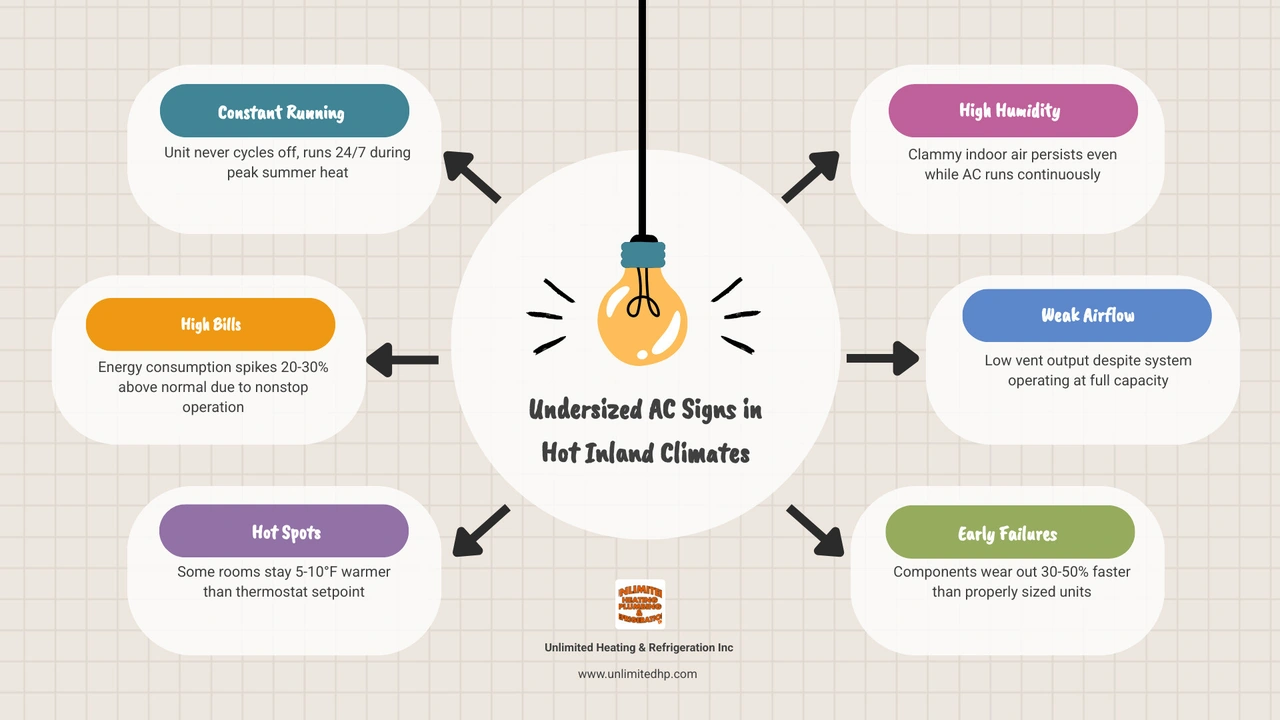
Here are the most common signs your AC is undersized for a hot inland climate:
- AC runs constantly without ever reaching your thermostat setting
- Indoor temps stay 5–10°F above setpoint during peak afternoon heat
- Hot spots or uneven cooling — some rooms feel fine, others feel like an oven
- High indoor humidity and a clammy, uncomfortable feeling despite the AC running
- Weak airflow from vents even when the system is working full blast
- Energy bills spike far beyond what the season should cost
- Frequent breakdowns from components wearing out faster than they should
Inland climates like the Palouse region around Moscow, ID, push air conditioners far harder than milder or coastal areas. Summer design temperatures here can exceed 95°F — and attic temperatures can climb even higher — creating a heat load that an undersized system simply cannot overcome. Unlike coastal areas that benefit from marine air and moderate overnight lows, inland homes face relentless heat with little natural relief.
The result? A unit that runs nonstop, never cycles off, and wears out years ahead of schedule. Research shows that undersized AC systems can fail 30–50% sooner than properly sized ones, and can increase energy consumption by 20–30% due to continuous operation.
This guide walks you through every sign to watch for, what the long-term damage looks like, and how to get the right fix.
Understanding Undersized AC Unit Signs and Problems in a Hot Inland Climate
To understand why an undersized air conditioner struggles so mightily, we have to look at how an AC actually works. Many people assume an air conditioner "creates" cold air and blows it into a room like an open freezer door. In reality, your AC is a heat transfer machine. It extracts thermal energy from inside your living spaces, dumps it outdoors, and returns the cooled air back to your home.
When your system is properly sized, it manages this heat transfer in balanced, efficient cycles. It runs for 15 to 20 minutes, lowers the indoor temperature to your thermostat's setpoint, and then shuts down to rest.
However, when you are dealing with an undersized system in a hot, dry inland climate, the rate of heat entering your home exceeds the rate at which the AC can extract it. During a scorching July afternoon in Pullman or Lewiston, heat radiates through your roof, walls, and windows faster than a small system can pump it out.
This leads to the classic symptom of a system that is simply outmatched. If you find your AC running constantly in Palouse summer heat, it is trying desperately to reach a temperature target it is physically incapable of hitting. The system runs 24/7, but the thermostat remains stuck at 78°F or 80°F when you wanted a comfortable 72°F. This continuous operation without cycling is the most glaring warning sign of an undersized system.
How to Spot Undersized AC Unit Signs and Problems in a Hot Inland Climate
While constant running is the most obvious indicator, there are several other subtle signs of an undersized air conditioner that affect your daily comfort and indoor air quality:
- Uneven Cooling and Hot Spots: You might notice that the room closest to your indoor air handler feels reasonably comfortable, while upstairs bedrooms, kitchens, or rooms with west-facing windows feel like saunas. An undersized unit lacks the static pressure and capacity to distribute conditioned air evenly to the far corners of your home.
- High Indoor Humidity and Clammy Air: Even though our inland climate is generally dry, daily household activities like showering, cooking, and breathing introduce moisture indoors. A properly sized AC dehumidifies your home as it cools. However, because an undersized system is constantly overwhelmed and never completes a proper cycle, it fails to maintain the ideal 30% to 50% relative humidity range, leaving your indoor air feeling sticky and clammy.
- Weak Airflow from Vents: If the air coming out of your registers feels barely cool or lacks velocity, your system is struggling to push enough volume through your ductwork to overcome the rising heat load.
Before you assume your system is permanently too small, it is always a good idea to perform some basic AC troubleshooting before calling a pro to rule out simple issues like a clogged air filter or blocked return vents.
Why Inland Heat Multiplies Undersized AC Unit Signs and Problems in a Hot Inland Climate
Geography plays a massive role in how your air conditioner performs. Homeowners living in coastal areas benefit from a natural marine layer, higher humidity that buffers temperature swings, and lower summer design temperatures (often in the low-to-mid 80s).
In contrast, hot inland climates like Moscow, ID, and Colfax, WA, experience much higher summer design temperatures, often soaring past 95°F. The air is dry, the solar radiation is intense, and the temperature swings between day and night can be extreme.
This inland heat multiplies the stress on an undersized AC in several ways:
- Attic Heat Gain: In the inland valleys, attic temperatures can easily climb past 150°F. If your ductwork runs through your attic, those ducts are sitting in an oven. An undersized system running cool air through blistering hot ducts loses much of its cooling capacity before the air even reaches your living spaces.
- Relentless Solar Radiation: Without coastal cloud cover or marine fog, inland homes face direct, intense sunlight for up to 15 hours a day in mid-summer. This creates massive radiant heat gain through windows and roofing materials.
- Dust and Particulates: Inland regions are prone to heavy dust, agricultural harvesting debris, and dry winds. When extreme heat combined with heavy dust exposure shortens AC lifespan, it severely compromises an already undersized system. Dust coats the outdoor condenser coils, acting as an insulating blanket that prevents the system from releasing heat, making an underpowered system perform even worse.
The Long-Term Impact of an Underpowered AC on Your Home
Living with an undersized air conditioner is not just a matter of dealing with a little sweat during the hottest hours of the day. It is a financial and mechanical ticking time bomb.
When an AC is forced to run continuously without a break, its internal components are subjected to extreme thermal and mechanical stress. Under normal conditions, a high-quality cooling system should last between 12 and 15 years. However, in our demanding inland climate, an overworked, undersized system often experiences catastrophic compressor failure by year 7 or 8.
If you are dealing with an aging system, you might find yourself asking is a 15-year-old AC worth fixing in a hot Palouse summer climate? The answer is almost always a resounding no—especially if that system was undersized to begin with. Continuing to pour money into repairs for an underpowered unit is simply throwing good money after bad.
To help visualize the difference, look at how a properly sized system compares to an undersized unit during a typical inland summer:
| Performance Metric | Properly Sized AC System | Undersized AC System |
|---|---|---|
| Typical Run Cycle | 15–20 minutes, 2–3 times per hour | Continuous (24/7 during heatwaves) |
| Indoor Temperature | Holds steady at thermostat setpoint | Rises 5–10°F above setpoint in afternoon |
| Energy Consumption | Optimized; cycles off to save power | 20–30% higher due to nonstop operation |
| Indoor Humidity | Maintained at comfortable 30–50% | High, leading to a clammy indoor feel |
| Equipment Lifespan | 12–15 years with regular maintenance | 5–8 years due to constant mechanical strain |
| Repair Frequency | Low; standard wear-and-tear | High; frequent component failures |
Accelerated Wear and Component Failures
The mechanical strain of running nonstop leads directly to expensive component failures. Two of the most common issues we see with overworked systems are:
- Frozen Evaporator Coils: It sounds counterintuitive, but an air conditioner can actually freeze up in the middle of a 100°F summer day. When an undersized unit runs continuously, the temperature of the indoor evaporator coil drops below freezing. Without adequate downtime to allow the system to balance, moisture extracted from the air turns to ice on the coils. This ice blocks airflow entirely, causing the system to blow warm air and potentially damaging the compressor.
- Capacitor Failure: Electrical capacitors act like short-term batteries that help start and run your AC motors. Continuous runtime in extreme heat causes these components to overheat. This is a primary reason why AC capacitors fail during Palouse summer heat waves, shutting down your entire system right when you need it most.
Skyrocketing Energy Consumption
Because an undersized AC never reaches the thermostat setpoint, it never shuts off. Running a 3-ton compressor and blower motor 24 hours a day consumes vastly more electricity than running a properly sized 4-ton system that cycles on and off as designed.
Homeowners with undersized systems often see their summer utility bills climb by 20% to 30% compared to what a correctly sized system would cost to run. While you might think you are saving money by keeping a smaller, older unit, you are actually paying a massive premium on your monthly power bills.
Understanding how maintenance extends AC life in a hot dry inland climate is crucial, but even the most meticulous maintenance cannot make up for a physical lack of cooling capacity.
How Professionals Determine the Right AC Size for Inland Homes
So, how do we avoid the trap of installing an undersized system? It all comes down to professional engineering calculations.
Many amateur installers or cut-rate handymen rely on outdated "rules of thumb" to size air conditioners. They might look at your home's square footage and declare, "You need a 3-ton unit."
This is a recipe for disaster. To get a truly comfortable, efficient home, a professional HVAC technician must perform a Manual J Load Calculation. This detailed calculation is the industry standard for determining exact heating and cooling loads.
A proper Manual J calculation takes into account:
- The exact square footage and ceiling heights of your home
- The local climate zone and outdoor design temperatures
- The R-value of your wall, floor, and attic insulation
- The number, size, and orientation of your windows (west-facing windows add massive heat loads!)
- The layout, insulation, and airtightness of your ductwork
- The heat generated by appliances and the number of occupants in the home
If your system is showing its age and you are trying to figure out how do you know when your air conditioner needs to be replaced, a professional load calculation is the first step in planning a successful upgrade.
Why Rules of Thumb Fail in the Palouse Region
Relying on simple square-footage charts is incredibly risky in the Palouse. A 2,000-square-foot home built in Lewiston in 1970 with original single-pane windows and minimal insulation has a vastly different cooling load than a highly efficient, modern 2,000-square-foot home built in Moscow in 2024.
Furthermore, microclimates matter. Lewiston sits in a deep valley with significantly hotter summer temperatures than the surrounding hills of Pullman or Moscow. A system sized for a home on the hill will be severely undersized if installed in an identical home down in the valley.
Additionally, factors like home additions, converted attics, or leaky, uninsulated ductwork can easily push a home's actual heat load far beyond what a standard chart would suggest. If you are noticing persistent comfort issues, it is highly recommended to review the signs you need an AC replacement with an experienced technician who understands the local geography.
Frequently Asked Questions About AC Sizing
Can adding insulation fix an undersized AC unit?
In some minor cases, yes. If your air conditioner is only slightly undersized—say, it struggles only on the three hottest days of the year—improving your home's thermal envelope can help. Adding high-quality attic insulation (aiming for R-38 or R-49) and sealing air leaks around windows and doors reduces the overall heat load entering your living spaces. This makes it easier for a slightly underpowered system to keep up.
However, if your system is significantly undersized (e.g., a 2-ton system trying to cool a home that requires 3.5 tons), adding insulation will not bridge that massive gap. The system will still run constantly and struggle during peak summer heat.
How do I know if my AC is struggling due to size or a maintenance issue?
This is a very common point of confusion. A system with a dirty air filter, low refrigerant due to a leak, or a failing blower motor will exhibit many of the same symptoms as an undersized unit, such as constant running and warm air.
The easiest way to tell the difference is to look at the system's history. If your AC kept your home perfectly cool last summer but is suddenly struggling this year, you are likely dealing with a maintenance or mechanical issue. On the other hand, if the system has struggled every single summer since it was installed, it is almost certainly undersized.
To prevent these issues from compounding, keeping up with regular AC maintenance for homes is essential to ensure your system is operating at its maximum physical capacity.
Is it better to repair or replace an undersized system?
If your system is truly undersized for your home and climate, repairing it is usually a temporary band-aid. You can replace failed capacitors, swap out worn fan motors, or patch refrigerant leaks, but you cannot change the physical size of the compressor or the evaporator coils. The underlying issue of overwork and thermal strain will remain, leading to more breakdowns in the future.
When deciding, you should evaluate how much AC repair is too much before replacing the unit. If your unit is more than 10 years old, uses outdated R-22 refrigerant, and is physically too small to keep your family comfortable, investing those repair dollars into a properly sized, energy-efficient replacement is the smarter, more cost-effective long-term choice.
Conclusion
Dealing with undersized ac unit signs and problems in a hot inland climate is a stressful, uncomfortable, and expensive experience. From sky-high utility bills to frequent mid-summer breakdowns, an underpowered cooling system simply cannot stand up to the relentless heat of a Palouse summer.
At Unlimited Heating & Refrigeration Inc, we have spent over 20 years helping our neighbors in Moscow, ID, and the surrounding areas stay comfortable all year round. As a family-owned business and a trusted Daikin dealer, we stand behind our work with our outstanding 12-year warranty and Comfort Promise. We don't guess when it comes to your comfort—we perform precise, professional load calculations to ensure your new cooling system is perfectly sized for your unique home and our demanding inland climate.
Don't spend another summer sweating through the afternoons and dreading your electric bill. Schedule professional cooling services today with our friendly team, and let us bring reliable, efficient comfort back to your home.
When Your AC Can't Keep Up: Undersized AC Unit Signs and Problems in a Hot Inland Climate
Undersized AC unit signs and problems in a hot inland climate are more common than most homeowners realize — and they often go unnoticed until the system is already failing. If your home never seems to cool down no matter how long the AC runs, or your energy bills keep climbing through summer, your unit may simply not be built for the heat load your home actually creates.
Here are the most common signs your AC is undersized for a hot inland climate:
- AC runs constantly without ever reaching your thermostat setting
- Indoor temps stay 5–10°F above setpoint during peak afternoon heat
- Hot spots or uneven cooling — some rooms feel fine, others feel like an oven
- High indoor humidity and a clammy, uncomfortable feeling despite the AC running
- Weak airflow from vents even when the system is working full blast
- Energy bills spike far beyond what the season should cost
- Frequent breakdowns from components wearing out faster than they should
Inland climates like the Palouse region around Moscow, ID, push air conditioners far harder than milder or coastal areas. Summer design temperatures here can exceed 95°F — and attic temperatures can climb even higher — creating a heat load that an undersized system simply cannot overcome. Unlike coastal areas that benefit from marine air and moderate overnight lows, inland homes face relentless heat with little natural relief.
The result? A unit that runs nonstop, never cycles off, and wears out years ahead of schedule. Research shows that undersized AC systems can fail 30–50% sooner than properly sized ones, and can increase energy consumption by 20–30% due to continuous operation.
This guide walks you through every sign to watch for, what the long-term damage looks like, and how to get the right fix.

Understanding Undersized AC Unit Signs and Problems in a Hot Inland Climate
To understand why an undersized air conditioner struggles so mightily, we have to look at how an AC actually works. Many people assume an air conditioner "creates" cold air and blows it into a room like an open freezer door. In reality, your AC is a heat transfer machine. It extracts thermal energy from inside your living spaces, dumps it outdoors, and returns the cooled air back to your home.
When your system is properly sized, it manages this heat transfer in balanced, efficient cycles. It runs for 15 to 20 minutes, lowers the indoor temperature to your thermostat's setpoint, and then shuts down to rest.

However, when you are dealing with an undersized system in a hot, dry inland climate, the rate of heat entering your home exceeds the rate at which the AC can extract it. During a scorching July afternoon in Pullman or Lewiston, heat radiates through your roof, walls, and windows faster than a small system can pump it out.
This leads to the classic symptom of a system that is simply outmatched. If you find your AC running constantly in Palouse summer heat, it is trying desperately to reach a temperature target it is physically incapable of hitting. The system runs 24/7, but the thermostat remains stuck at 78°F or 80°F when you wanted a comfortable 72°F. This continuous operation without cycling is the most glaring warning sign of an undersized system.
How to Spot Undersized AC Unit Signs and Problems in a Hot Inland Climate
While constant running is the most obvious indicator, there are several other subtle signs of an undersized air conditioner that affect your daily comfort and indoor air quality:
- Uneven Cooling and Hot Spots: You might notice that the room closest to your indoor air handler feels reasonably comfortable, while upstairs bedrooms, kitchens, or rooms with west-facing windows feel like saunas. An undersized unit lacks the static pressure and capacity to distribute conditioned air evenly to the far corners of your home.
- High Indoor Humidity and Clammy Air: Even though our inland climate is generally dry, daily household activities like showering, cooking, and breathing introduce moisture indoors. A properly sized AC dehumidifies your home as it cools. However, because an undersized system is constantly overwhelmed and never completes a proper cycle, it fails to maintain the ideal 30% to 50% relative humidity range, leaving your indoor air feeling sticky and clammy.
- Weak Airflow from Vents: If the air coming out of your registers feels barely cool or lacks velocity, your system is struggling to push enough volume through your ductwork to overcome the rising heat load.
Before you assume your system is permanently too small, it is always a good idea to perform some basic AC troubleshooting before calling a pro to rule out simple issues like a clogged air filter or blocked return vents.
Why Inland Heat Multiplies Undersized AC Unit Signs and Problems in a Hot Inland Climate
Geography plays a massive role in how your air conditioner performs. Homeowners living in coastal areas benefit from a natural marine layer, higher humidity that buffers temperature swings, and lower summer design temperatures (often in the low-to-mid 80s).
In contrast, hot inland climates like Moscow, ID, and Colfax, WA, experience much higher summer design temperatures, often soaring past 95°F. The air is dry, the solar radiation is intense, and the temperature swings between day and night can be extreme.
This inland heat multiplies the stress on an undersized AC in several ways:
- Attic Heat Gain: In the inland valleys, attic temperatures can easily climb past 150°F. If your ductwork runs through your attic, those ducts are sitting in an oven. An undersized system running cool air through blistering hot ducts loses much of its cooling capacity before the air even reaches your living spaces.
- Relentless Solar Radiation: Without coastal cloud cover or marine fog, inland homes face direct, intense sunlight for up to 15 hours a day in mid-summer. This creates massive radiant heat gain through windows and roofing materials.
- Dust and Particulates: Inland regions are prone to heavy dust, agricultural harvesting debris, and dry winds. When extreme heat combined with heavy dust exposure shortens AC lifespan, it severely compromises an already undersized system. Dust coats the outdoor condenser coils, acting as an insulating blanket that prevents the system from releasing heat, making an underpowered system perform even worse.
The Long-Term Impact of an Underpowered AC on Your Home
Living with an undersized air conditioner is not just a matter of dealing with a little sweat during the hottest hours of the day. It is a financial and mechanical ticking time bomb.
When an AC is forced to run continuously without a break, its internal components are subjected to extreme thermal and mechanical stress. Under normal conditions, a high-quality cooling system should last between 12 and 15 years. However, in our demanding inland climate, an overworked, undersized system often experiences catastrophic compressor failure by year 7 or 8.
If you are dealing with an aging system, you might find yourself asking is a 15-year-old AC worth fixing in a hot Palouse summer climate? The answer is almost always a resounding no—especially if that system was undersized to begin with. Continuing to pour money into repairs for an underpowered unit is simply throwing good money after bad.
To help visualize the difference, look at how a properly sized system compares to an undersized unit during a typical inland summer:
| Performance Metric | Properly Sized AC System | Undersized AC System |
|---|---|---|
| Typical Run Cycle | 15–20 minutes, 2–3 times per hour | Continuous (24/7 during heatwaves) |
| Indoor Temperature | Holds steady at thermostat setpoint | Rises 5–10°F above setpoint in afternoon |
| Energy Consumption | Optimized; cycles off to save power | 20–30% higher due to nonstop operation |
| Indoor Humidity | Maintained at comfortable 30–50% | High, leading to a clammy indoor feel |
| Equipment Lifespan | 12–15 years with regular maintenance | 5–8 years due to constant mechanical strain |
| Repair Frequency | Low; standard wear-and-tear | High; frequent component failures |
Accelerated Wear and Component Failures
The mechanical strain of running nonstop leads directly to expensive component failures. Two of the most common issues we see with overworked systems are:
- Frozen Evaporator Coils: It sounds counterintuitive, but an air conditioner can actually freeze up in the middle of a 100°F summer day. When an undersized unit runs continuously, the temperature of the indoor evaporator coil drops below freezing. Without adequate downtime to allow the system to balance, moisture extracted from the air turns to ice on the coils. This ice blocks airflow entirely, causing the system to blow warm air and potentially damaging the compressor.
- Capacitor Failure: Electrical capacitors act like short-term batteries that help start and run your AC motors. Continuous runtime in extreme heat causes these components to overheat. This is a primary reason why AC capacitors fail during Palouse summer heat waves, shutting down your entire system right when you need it most.
Skyrocketing Energy Consumption
Because an undersized AC never reaches the thermostat setpoint, it never shuts off. Running a 3-ton compressor and blower motor 24 hours a day consumes vastly more electricity than running a properly sized 4-ton system that cycles on and off as designed.
Homeowners with undersized systems often see their summer utility bills climb by 20% to 30% compared to what a correctly sized system would cost to run. While you might think you are saving money by keeping a smaller, older unit, you are actually paying a massive premium on your monthly power bills.
Understanding how maintenance extends AC life in a hot dry inland climate is crucial, but even the most meticulous maintenance cannot make up for a physical lack of cooling capacity.
How Professionals Determine the Right AC Size for Inland Homes
So, how do we avoid the trap of installing an undersized system? It all comes down to professional engineering calculations.
Many amateur installers or cut-rate handymen rely on outdated "rules of thumb" to size air conditioners. They might look at your home's square footage and declare, "You need a 3-ton unit."
This is a recipe for disaster. To get a truly comfortable, efficient home, a professional HVAC technician must perform a Manual J Load Calculation. This detailed calculation is the industry standard for determining exact heating and cooling loads.
A proper Manual J calculation takes into account:
- The exact square footage and ceiling heights of your home
- The local climate zone and outdoor design temperatures
- The R-value of your wall, floor, and attic insulation
- The number, size, and orientation of your windows (west-facing windows add massive heat loads!)
- The layout, insulation, and airtightness of your ductwork
- The heat generated by appliances and the number of occupants in the home
If your system is showing its age and you are trying to figure out how do you know when your air conditioner needs to be replaced, a professional load calculation is the first step in planning a successful upgrade.
Why Rules of Thumb Fail in the Palouse Region
Relying on simple square-footage charts is incredibly risky in the Palouse. A 2,000-square-foot home built in Lewiston in 1970 with original single-pane windows and minimal insulation has a vastly different cooling load than a highly efficient, modern 2,000-square-foot home built in Moscow in 2024.
Furthermore, microclimates matter. Lewiston sits in a deep valley with significantly hotter summer temperatures than the surrounding hills of Pullman or Moscow. A system sized for a home on the hill will be severely undersized if installed in an identical home down in the valley.
Additionally, factors like home additions, converted attics, or leaky, uninsulated ductwork can easily push a home's actual heat load far beyond what a standard chart would suggest. If you are noticing persistent comfort issues, it is highly recommended to review the signs you need an AC replacement with an experienced technician who understands the local geography.
Frequently Asked Questions About AC Sizing
Can adding insulation fix an undersized AC unit?
In some minor cases, yes. If your air conditioner is only slightly undersized—say, it struggles only on the three hottest days of the year—improving your home's thermal envelope can help. Adding high-quality attic insulation (aiming for R-38 or R-49) and sealing air leaks around windows and doors reduces the overall heat load entering your living spaces. This makes it easier for a slightly underpowered system to keep up.
However, if your system is significantly undersized (e.g., a 2-ton system trying to cool a home that requires 3.5 tons), adding insulation will not bridge that massive gap. The system will still run constantly and struggle during peak summer heat.
How do I know if my AC is struggling due to size or a maintenance issue?
This is a very common point of confusion. A system with a dirty air filter, low refrigerant due to a leak, or a failing blower motor will exhibit many of the same symptoms as an undersized unit, such as constant running and warm air.
The easiest way to tell the difference is to look at the system's history. If your AC kept your home perfectly cool last summer but is suddenly struggling this year, you are likely dealing with a maintenance or mechanical issue. On the other hand, if the system has struggled every single summer since it was installed, it is almost certainly undersized.
To prevent these issues from compounding, keeping up with regular AC maintenance for homes is essential to ensure your system is operating at its maximum physical capacity.
Is it better to repair or replace an undersized system?
If your system is truly undersized for your home and climate, repairing it is usually a temporary band-aid. You can replace failed capacitors, swap out worn fan motors, or patch refrigerant leaks, but you cannot change the physical size of the compressor or the evaporator coils. The underlying issue of overwork and thermal strain will remain, leading to more breakdowns in the future.
When deciding, you should evaluate how much AC repair is too much before replacing the unit. If your unit is more than 10 years old, uses outdated R-22 refrigerant, and is physically too small to keep your family comfortable, investing those repair dollars into a properly sized, energy-efficient replacement is the smarter, more cost-effective long-term choice.
Conclusion
Dealing with undersized ac unit signs and problems in a hot inland climate is a stressful, uncomfortable, and expensive experience. From sky-high utility bills to frequent mid-summer breakdowns, an underpowered cooling system simply cannot stand up to the relentless heat of a Palouse summer.
At Unlimited Heating & Refrigeration Inc, we have spent over 20 years helping our neighbors in Moscow, ID, and the surrounding areas stay comfortable all year round. As a family-owned business and a trusted Daikin dealer, we stand behind our work with our outstanding 12-year warranty and Comfort Promise. We don't guess when it comes to your comfort—we perform precise, professional load calculations to ensure your new cooling system is perfectly sized for your unique home and our demanding inland climate.
Don't spend another summer sweating through the afternoons and dreading your electric bill. Schedule professional cooling services today with our friendly team, and let us bring reliable, efficient comfort back to your home.
Customer Testimonials
Our customers love our service and support.


