Why Is My AC Blowing Warm Air in Summer? (Quick Answer)
If you're wondering why is my AC blowing warm air in summer, you're not alone — and the good news is that most causes are diagnosable without calling a technician right away. Here are the most common reasons:
- Thermostat set to HEAT or fan set to ON instead of AUTO
- Dirty or clogged air filter blocking airflow to the evaporator coil
- Blocked outdoor condenser unit covered in debris, grass, or dirt
- Low refrigerant due to a leak in the sealed system
- Tripped circuit breaker cutting power to the outdoor unit
- Frozen evaporator coil caused by restricted airflow or low refrigerant
- Failing capacitor, contactor, or compressor in the outdoor unit
It happens more than you'd think in Moscow, ID — a summer heatwave hits, you walk through the front door, and instead of cool relief, you're met with a wave of warm, stuffy air blowing from the vents. Something in your AC's heat transfer process has broken down, and the system is running without actually cooling your home.
About 90% of the time, the root cause traces back to the outdoor condenser unit. But before you assume the worst, there are several quick checks you can do yourself. This guide walks you through all of them.

Why is my ac blowing warm air in summer terms simplified:
- AC keeps turning on and off what is wrong
- AC not cooling but running what to check first
- AC troubleshooting before calling a pro
Understanding the Cooling Process: Why Is My AC Blowing Warm Air in Summer?
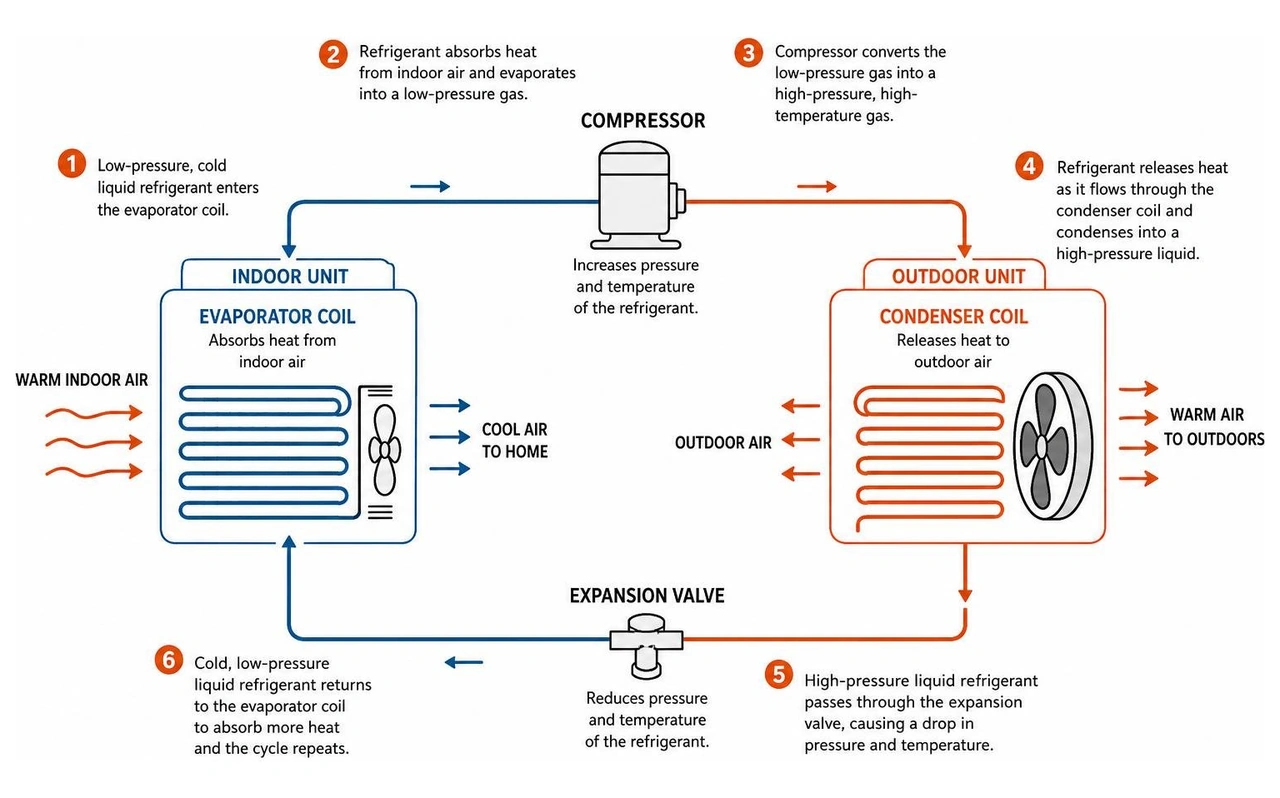
To understand how a cooling system fails, it helps to understand how it actually works. A common misconception is that air conditioners create "cold" out of thin air. In reality, your AC is a heat mover. It relies on a continuous refrigeration cycle to extract heat from inside your home and dump it outdoors.
This process depends on several key components working in perfect harmony:
- The Evaporator Coil (Indoor Unit): Cold, low-pressure liquid refrigerant flows through this coil. As warm indoor air is blown across it by the blower fan, the refrigerant absorbs the heat from the air. This causes the refrigerant to heat up and evaporate into a gas, while the newly cooled air is distributed back through your ductwork.
- The Compressor (Outdoor Unit): Often called the "heart" of the system, the compressor pumps the warm, gaseous refrigerant from the indoor unit and compresses it into a high-pressure, hot gas.
- The Condenser Coil (Outdoor Unit): The hot gas flows through the outdoor coils. A large fan blows outdoor air across these coils, transferring the heat from the refrigerant to the outside air. As it cools, the refrigerant condenses back into a liquid and returns indoors to start the cycle again.
When this heat transfer process is interrupted, the cooling cycle breaks down. Without proper airflow or sufficient refrigerant, the heat cannot be absorbed or released. This often leads to frozen indoor components. If you notice ice forming on your indoor unit's copper lines, you may be dealing with a classic freeze-up. To understand why this happens and what to do next, check out our guide on Why Your AC Unit Is Freezing Up Lewiston.
To help visualize how normal cooling compares to a system failure, look at the comparison table below:
| System State | Indoor Evaporator Coil | Outdoor Condenser Unit | Air From Vents | Root Cause |
|---|---|---|---|---|
| Normal Cooling | Cold (approx. 40°F); absorbs heat | Hot; expels heat outdoor | Cool, refreshing air (55-60°F) | System is clean, fully charged, and powered |
| Airflow Blockage | Extremely cold; ice forms on coils | Warm or cool; minimal heat transfer | Warm or room-temperature air | Dirty air filter or blocked return vents |
| Refrigerant Deficit | Warm or freezing in patches | Cool; fan blows cool air outside | Warm air | Refrigerant leak in the lines |
| Outdoor Power Loss | Room temperature; fan runs | Completely off; no fan or compressor | Warm air | Tripped breaker or failed capacitor |
Common Airflow and Thermostat Issues to Check First
When your home starts warming up in July 2026, the first place you should look is not the outdoor unit, but your indoor thermostat and air filter. These components are responsible for a surprising number of service calls, many of which can be resolved in under five minutes.
If your system is humming along but the air coming out of your registers is lukewarm, you need to isolate whether the issue is electrical, mechanical, or a simple airflow restriction. For a deeper look into the initial diagnostic steps, check out our resource on AC Not Cooling But Running What to Check First.
How a Clogged Filter Explains Why Is My AC Blowing Warm Air in Summer
A dirty or clogged air filter is the single most common cause of an AC blowing warm air. In fact, dirty filters increase your system's energy consumption by up to 15% because the blower fan has to work twice as hard to pull air through the dust-caked fibers.
When airflow is severely restricted:
- The cold refrigerant inside the indoor evaporator coil doesn't get enough warm air passing over it.
- Without heat to absorb, the temperature of the coil drops below freezing.
- Condensation on the coil quickly turns to ice, creating a literal block of ice that completely stops any remaining airflow.
- Your system overheats, potentially tripping safety switches or blowing warm, uncooled air into your rooms.
Checking and replacing your filter every 30 to 60 days during peak summer is the easiest way to prevent this. If you want to run through a quick checklist before calling in the professionals, read our guide on AC Troubleshooting Before Calling a Pro.
Thermostat Malfunctions and Incorrect Settings
Sometimes, the solution is as simple as a bumped switch. If a family member or guest accidentally changed the settings, your AC might behave unexpectedly.
- The "ON" vs. "AUTO" Fan Setting: If your thermostat fan is set to "ON," the indoor blower fan runs constantly, even when the outdoor compressor isn't actively cooling. During the cycles when the compressor is off, the fan simply circulates uncooled, room-temperature (or warm) air through your home. Always switch this setting to "AUTO" so the fan only runs when the system is actively cooling.
- The "HEAT" Mode Slip: Double-check that the thermostat didn't get switched to "HEAT" by mistake. It sounds obvious, but it happens more often than most homeowners care to admit!
- Low Batteries: A fading battery in a digital thermostat can cause it to lose communication with the outdoor unit, leaving your indoor fan running while the outdoor compressor remains off.
- Smart Thermostat Glitches: Modern smart thermostats occasionally experience software glitches or wiring short-circuits. If you've recently installed a new smart thermostat and your system is suddenly blowing warm air, incorrect wiring could be preventing the outdoor unit from receiving the signal to turn on.
Outdoor Condenser and Refrigerant Problems
If your thermostat settings are correct and your air filter is clean, the problem almost certainly lies outdoors. Roughly 90% of all warm air complaints stem from the outdoor condenser unit. When the outdoor unit cannot expel heat, the entire indoor cooling process comes to a grinding halt.
During peak summer in the Palouse, your system has to work incredibly hard against high outdoor temperatures. If the outdoor unit is struggling, it can lead to a system that never shuts off while failing to cool. To understand the strain this puts on your system, read about AC Running Constantly in Palouse Summer Heat.
Low Refrigerant and the Mystery of Why Is My AC Blowing Warm Air in Summer
A very common issue is low refrigerant. It is vital to understand that an air conditioner does not "use up" refrigerant like a car uses gasoline. Your AC is a sealed, closed-loop system. If the refrigerant level is low, it means you have a leak.
When refrigerant leaks out of the copper lines:
- The system loses its capacity to absorb heat from your indoor air.
- The compressor works harder and hotter, which can lead to permanent mechanical damage.
- You may hear a faint hissing or bubbling noise near the indoor or outdoor coils.
- Ice may begin to form on the copper refrigerant lines leading to the outdoor unit.
To diagnose a leak, professional technicians often perform a "soap bubble test," spraying a specialized solution on the joints of the refrigerant lines to watch for escaping gas bubbles. Because handling refrigerant requires specialized EPA certification, this is not a DIY project. Running a system that is low on refrigerant can lead to rapid cycling and compressor burnout. If your system is cycling rapidly, check out our analysis on AC Keeps Turning On and Off What Is Wrong.
Electrical Failures: Capacitors, Contactors, and Breakers
Your outdoor unit requires a massive amount of electrical power to run the compressor and the condenser fan. Because of this, it has its own dedicated electrical components that are highly susceptible to wear and tear, especially during the first major heatwave of the summer.
- Tripped Circuit Breaker: Your indoor air handler and outdoor condenser run on separate circuits. If the outdoor breaker trips, your indoor unit will keep blowing air, but because the outdoor unit has no power, that air will be warm. Note: If you reset the breaker and it immediately trips a second time, do not reset it again. This indicates a direct electrical short or a failing compressor.
- Failed Capacitor: The capacitor acts like a large battery that gives the compressor and outdoor fan the electrical "boost" they need to start up. If the capacitor fails (often bulging or leaking oil), the outdoor fan or compressor won't start, resulting in warm air indoors.
- Failing Compressor: The compressor is the most expensive component in your AC. If it fails mechanically or overheats, it will stop pumping refrigerant entirely.
Knowing when these components are failing can save you from a catastrophic system breakdown. Read our expert advice on the Right Time for AC Repair Tips From Experts.
Step-by-Step Homeowner Troubleshooting Guide
Before you pick up the phone to schedule a service call, run through these safe, step-by-step troubleshooting measures to see if you can resolve the issue yourself.
- Perform a Thermostat Reset: Switch your thermostat to "OFF." Wait 5 minutes, then switch it back to "COOL" and ensure the fan is set to "AUTO." If your thermostat uses batteries, put in a fresh set of AA or AAA batteries.
- Inspect and Replace the Air Filter: Pull out your indoor air filter. Hold it up to a light source. If you cannot see light passing through the filter, it is completely clogged and must be replaced immediately.
- Check the Outdoor Unit's Power: Go outside and verify if the outdoor fan is spinning and you can hear the hum of the compressor. If the outdoor unit is completely silent, check your home’s main electrical panel. Look for a tripped breaker labeled "AC" or "Condenser." If it is tripped, flip it fully to "OFF" and then back to "ON" once.
- Clean Around the Condenser: Clear away any tall grass, weeds, leaves, or shrubs within a two-foot radius of your outdoor unit. If the metal fins of the condenser are caked in dirt, dust, or cottonwood, turn off the system at the thermostat. Use a garden hose with a gentle spray nozzle (never use a pressure washer, as it will bend the delicate aluminum fins) to wash the coils from the top down.
- Check for Frozen Coils: Look at the brass valves and copper lines on your outdoor unit. If you see ice or frost coating them, your indoor evaporator coil is likely frozen solid. Turn your thermostat to "OFF" and switch the fan setting to "ON." This runs the indoor fan to help melt the ice over the next 12 to 24 hours. Keep the system off until the ice has completely melted.
Frequently Asked Questions About Summer AC Performance
Should I turn off my AC if it is blowing warm air?
Yes, absolutely. If your air conditioner is blowing warm air, you should turn it off at the thermostat immediately. Continuing to run a malfunctioning system can cause severe, permanent damage to your compressor.
If the problem is a refrigerant leak, running the system dry can destroy the compressor's internal valves. If the issue is a frozen coil, continuing to run the system risks "refrigerant slugging"—a dangerous condition where liquid refrigerant travels back into the compressor, causing instant mechanical failure. Turn the cooling mode off and switch the fan to "ON" to safely circulate air while you diagnose the issue.
How long should it take for my AC to blow cold air?
A properly functioning central air conditioning system should begin blowing noticeably cool air from your vents within 5 to 15 minutes of starting up.
Technicians measure this performance using a metric called "temperature split" or "Delta T." This is the temperature difference between the air entering your return vents and the air blowing out of your supply vents. In a healthy system, the temperature split should be between 16°F and 20°F. If the air coming out of your vents is only a few degrees cooler than the room temperature after 20 minutes of continuous operation, your system is struggling and requires attention.
What are the risks of ignoring an AC that blows warm air?
Ignoring an AC that is blowing warm air can turn a simple, inexpensive fix into a complete system replacement.
- Compressor Burnout: Running a system with a failing capacitor, restricted airflow, or low refrigerant puts immense thermal strain on the compressor. If the compressor burns out, it is often more cost-effective to replace the entire outdoor unit rather than just the compressor.
- Skyrocketing Energy Bills: A system that isn't cooling will run continuously, consuming massive amounts of electricity without ever lowering your home's temperature.
- Water Damage: If your evaporator coil freezes and melts rapidly, the sudden rush of water can overflow your condensate drain pan, leading to water damage on your ceilings, walls, or flooring.
If your system is aging and you aren't sure whether to repair or replace it, consult our comprehensive AC Repair vs Replace Decision Guide.
Conclusion
When your air conditioner starts blowing warm air in the middle of a hot summer, it can quickly turn your comfortable home into an oven. While simple checks like replacing a dirty filter or clearing debris from your outdoor unit can solve the problem, many mechanical and electrical issues require professional expertise.
At Unlimited Heating & Refrigeration Inc, we have been keeping families comfortable across the region for over 20 years. As a family-owned business and a trusted Daikin dealer, we stand behind our work with an industry-leading 12-year warranty and our Comfort Promise. Whether you need a quick repair, routine maintenance, or are looking for long-term comfort with our AC Repair Solutions for Lewiston ID Homes, we are here to help.
Don't spend another hot day sweating indoors. Schedule professional service today with our experienced technicians and get your home back to the cool, refreshing sanctuary it should be.
Why Is My AC Blowing Warm Air in Summer? (Quick Answer)
If you're wondering why is my AC blowing warm air in summer, you're not alone — and the good news is that most causes are diagnosable without calling a technician right away. Here are the most common reasons:
- Thermostat set to HEAT or fan set to ON instead of AUTO
- Dirty or clogged air filter blocking airflow to the evaporator coil
- Blocked outdoor condenser unit covered in debris, grass, or dirt
- Low refrigerant due to a leak in the sealed system
- Tripped circuit breaker cutting power to the outdoor unit
- Frozen evaporator coil caused by restricted airflow or low refrigerant
- Failing capacitor, contactor, or compressor in the outdoor unit
It happens more than you'd think in Moscow, ID — a summer heatwave hits, you walk through the front door, and instead of cool relief, you're met with a wave of warm, stuffy air blowing from the vents. Something in your AC's heat transfer process has broken down, and the system is running without actually cooling your home.
About 90% of the time, the root cause traces back to the outdoor condenser unit. But before you assume the worst, there are several quick checks you can do yourself. This guide walks you through all of them.

Why is my ac blowing warm air in summer terms simplified:
- AC keeps turning on and off what is wrong
- AC not cooling but running what to check first
- AC troubleshooting before calling a pro
Understanding the Cooling Process: Why Is My AC Blowing Warm Air in Summer?
To understand how a cooling system fails, it helps to understand how it actually works. A common misconception is that air conditioners create "cold" out of thin air. In reality, your AC is a heat mover. It relies on a continuous refrigeration cycle to extract heat from inside your home and dump it outdoors.
This process depends on several key components working in perfect harmony:
- The Evaporator Coil (Indoor Unit): Cold, low-pressure liquid refrigerant flows through this coil. As warm indoor air is blown across it by the blower fan, the refrigerant absorbs the heat from the air. This causes the refrigerant to heat up and evaporate into a gas, while the newly cooled air is distributed back through your ductwork.
- The Compressor (Outdoor Unit): Often called the "heart" of the system, the compressor pumps the warm, gaseous refrigerant from the indoor unit and compresses it into a high-pressure, hot gas.
- The Condenser Coil (Outdoor Unit): The hot gas flows through the outdoor coils. A large fan blows outdoor air across these coils, transferring the heat from the refrigerant to the outside air. As it cools, the refrigerant condenses back into a liquid and returns indoors to start the cycle again.
When this heat transfer process is interrupted, the cooling cycle breaks down. Without proper airflow or sufficient refrigerant, the heat cannot be absorbed or released. This often leads to frozen indoor components. If you notice ice forming on your indoor unit's copper lines, you may be dealing with a classic freeze-up. To understand why this happens and what to do next, check out our guide on Why Your AC Unit Is Freezing Up Lewiston.

To help visualize how normal cooling compares to a system failure, look at the comparison table below:
| System State | Indoor Evaporator Coil | Outdoor Condenser Unit | Air From Vents | Root Cause |
|---|---|---|---|---|
| Normal Cooling | Cold (approx. 40°F); absorbs heat | Hot; expels heat outdoor | Cool, refreshing air (55-60°F) | System is clean, fully charged, and powered |
| Airflow Blockage | Extremely cold; ice forms on coils | Warm or cool; minimal heat transfer | Warm or room-temperature air | Dirty air filter or blocked return vents |
| Refrigerant Deficit | Warm or freezing in patches | Cool; fan blows cool air outside | Warm air | Refrigerant leak in the lines |
| Outdoor Power Loss | Room temperature; fan runs | Completely off; no fan or compressor | Warm air | Tripped breaker or failed capacitor |
Common Airflow and Thermostat Issues to Check First
When your home starts warming up in July 2026, the first place you should look is not the outdoor unit, but your indoor thermostat and air filter. These components are responsible for a surprising number of service calls, many of which can be resolved in under five minutes.
If your system is humming along but the air coming out of your registers is lukewarm, you need to isolate whether the issue is electrical, mechanical, or a simple airflow restriction. For a deeper look into the initial diagnostic steps, check out our resource on AC Not Cooling But Running What to Check First.
How a Clogged Filter Explains Why Is My AC Blowing Warm Air in Summer
A dirty or clogged air filter is the single most common cause of an AC blowing warm air. In fact, dirty filters increase your system's energy consumption by up to 15% because the blower fan has to work twice as hard to pull air through the dust-caked fibers.
When airflow is severely restricted:
- The cold refrigerant inside the indoor evaporator coil doesn't get enough warm air passing over it.
- Without heat to absorb, the temperature of the coil drops below freezing.
- Condensation on the coil quickly turns to ice, creating a literal block of ice that completely stops any remaining airflow.
- Your system overheats, potentially tripping safety switches or blowing warm, uncooled air into your rooms.
Checking and replacing your filter every 30 to 60 days during peak summer is the easiest way to prevent this. If you want to run through a quick checklist before calling in the professionals, read our guide on AC Troubleshooting Before Calling a Pro.
Thermostat Malfunctions and Incorrect Settings
Sometimes, the solution is as simple as a bumped switch. If a family member or guest accidentally changed the settings, your AC might behave unexpectedly.
- The "ON" vs. "AUTO" Fan Setting: If your thermostat fan is set to "ON," the indoor blower fan runs constantly, even when the outdoor compressor isn't actively cooling. During the cycles when the compressor is off, the fan simply circulates uncooled, room-temperature (or warm) air through your home. Always switch this setting to "AUTO" so the fan only runs when the system is actively cooling.
- The "HEAT" Mode Slip: Double-check that the thermostat didn't get switched to "HEAT" by mistake. It sounds obvious, but it happens more often than most homeowners care to admit!
- Low Batteries: A fading battery in a digital thermostat can cause it to lose communication with the outdoor unit, leaving your indoor fan running while the outdoor compressor remains off.
- Smart Thermostat Glitches: Modern smart thermostats occasionally experience software glitches or wiring short-circuits. If you've recently installed a new smart thermostat and your system is suddenly blowing warm air, incorrect wiring could be preventing the outdoor unit from receiving the signal to turn on.
Outdoor Condenser and Refrigerant Problems
If your thermostat settings are correct and your air filter is clean, the problem almost certainly lies outdoors. Roughly 90% of all warm air complaints stem from the outdoor condenser unit. When the outdoor unit cannot expel heat, the entire indoor cooling process comes to a grinding halt.
During peak summer in the Palouse, your system has to work incredibly hard against high outdoor temperatures. If the outdoor unit is struggling, it can lead to a system that never shuts off while failing to cool. To understand the strain this puts on your system, read about AC Running Constantly in Palouse Summer Heat.
Low Refrigerant and the Mystery of Why Is My AC Blowing Warm Air in Summer
A very common issue is low refrigerant. It is vital to understand that an air conditioner does not "use up" refrigerant like a car uses gasoline. Your AC is a sealed, closed-loop system. If the refrigerant level is low, it means you have a leak.
When refrigerant leaks out of the copper lines:
- The system loses its capacity to absorb heat from your indoor air.
- The compressor works harder and hotter, which can lead to permanent mechanical damage.
- You may hear a faint hissing or bubbling noise near the indoor or outdoor coils.
- Ice may begin to form on the copper refrigerant lines leading to the outdoor unit.
To diagnose a leak, professional technicians often perform a "soap bubble test," spraying a specialized solution on the joints of the refrigerant lines to watch for escaping gas bubbles. Because handling refrigerant requires specialized EPA certification, this is not a DIY project. Running a system that is low on refrigerant can lead to rapid cycling and compressor burnout. If your system is cycling rapidly, check out our analysis on AC Keeps Turning On and Off What Is Wrong.
Electrical Failures: Capacitors, Contactors, and Breakers
Your outdoor unit requires a massive amount of electrical power to run the compressor and the condenser fan. Because of this, it has its own dedicated electrical components that are highly susceptible to wear and tear, especially during the first major heatwave of the summer.
- Tripped Circuit Breaker: Your indoor air handler and outdoor condenser run on separate circuits. If the outdoor breaker trips, your indoor unit will keep blowing air, but because the outdoor unit has no power, that air will be warm. Note: If you reset the breaker and it immediately trips a second time, do not reset it again. This indicates a direct electrical short or a failing compressor.
- Failed Capacitor: The capacitor acts like a large battery that gives the compressor and outdoor fan the electrical "boost" they need to start up. If the capacitor fails (often bulging or leaking oil), the outdoor fan or compressor won't start, resulting in warm air indoors.
- Failing Compressor: The compressor is the most expensive component in your AC. If it fails mechanically or overheats, it will stop pumping refrigerant entirely.
Knowing when these components are failing can save you from a catastrophic system breakdown. Read our expert advice on the Right Time for AC Repair Tips From Experts.
Step-by-Step Homeowner Troubleshooting Guide
Before you pick up the phone to schedule a service call, run through these safe, step-by-step troubleshooting measures to see if you can resolve the issue yourself.
- Perform a Thermostat Reset: Switch your thermostat to "OFF." Wait 5 minutes, then switch it back to "COOL" and ensure the fan is set to "AUTO." If your thermostat uses batteries, put in a fresh set of AA or AAA batteries.
- Inspect and Replace the Air Filter: Pull out your indoor air filter. Hold it up to a light source. If you cannot see light passing through the filter, it is completely clogged and must be replaced immediately.
- Check the Outdoor Unit's Power: Go outside and verify if the outdoor fan is spinning and you can hear the hum of the compressor. If the outdoor unit is completely silent, check your home’s main electrical panel. Look for a tripped breaker labeled "AC" or "Condenser." If it is tripped, flip it fully to "OFF" and then back to "ON" once.
- Clean Around the Condenser: Clear away any tall grass, weeds, leaves, or shrubs within a two-foot radius of your outdoor unit. If the metal fins of the condenser are caked in dirt, dust, or cottonwood, turn off the system at the thermostat. Use a garden hose with a gentle spray nozzle (never use a pressure washer, as it will bend the delicate aluminum fins) to wash the coils from the top down.
- Check for Frozen Coils: Look at the brass valves and copper lines on your outdoor unit. If you see ice or frost coating them, your indoor evaporator coil is likely frozen solid. Turn your thermostat to "OFF" and switch the fan setting to "ON." This runs the indoor fan to help melt the ice over the next 12 to 24 hours. Keep the system off until the ice has completely melted.
Frequently Asked Questions About Summer AC Performance
Should I turn off my AC if it is blowing warm air?
Yes, absolutely. If your air conditioner is blowing warm air, you should turn it off at the thermostat immediately. Continuing to run a malfunctioning system can cause severe, permanent damage to your compressor.
If the problem is a refrigerant leak, running the system dry can destroy the compressor's internal valves. If the issue is a frozen coil, continuing to run the system risks "refrigerant slugging"—a dangerous condition where liquid refrigerant travels back into the compressor, causing instant mechanical failure. Turn the cooling mode off and switch the fan to "ON" to safely circulate air while you diagnose the issue.
How long should it take for my AC to blow cold air?
A properly functioning central air conditioning system should begin blowing noticeably cool air from your vents within 5 to 15 minutes of starting up.
Technicians measure this performance using a metric called "temperature split" or "Delta T." This is the temperature difference between the air entering your return vents and the air blowing out of your supply vents. In a healthy system, the temperature split should be between 16°F and 20°F. If the air coming out of your vents is only a few degrees cooler than the room temperature after 20 minutes of continuous operation, your system is struggling and requires attention.
What are the risks of ignoring an AC that blows warm air?
Ignoring an AC that is blowing warm air can turn a simple, inexpensive fix into a complete system replacement.
- Compressor Burnout: Running a system with a failing capacitor, restricted airflow, or low refrigerant puts immense thermal strain on the compressor. If the compressor burns out, it is often more cost-effective to replace the entire outdoor unit rather than just the compressor.
- Skyrocketing Energy Bills: A system that isn't cooling will run continuously, consuming massive amounts of electricity without ever lowering your home's temperature.
- Water Damage: If your evaporator coil freezes and melts rapidly, the sudden rush of water can overflow your condensate drain pan, leading to water damage on your ceilings, walls, or flooring.
If your system is aging and you aren't sure whether to repair or replace it, consult our comprehensive AC Repair vs Replace Decision Guide.
Conclusion
When your air conditioner starts blowing warm air in the middle of a hot summer, it can quickly turn your comfortable home into an oven. While simple checks like replacing a dirty filter or clearing debris from your outdoor unit can solve the problem, many mechanical and electrical issues require professional expertise.
At Unlimited Heating & Refrigeration Inc, we have been keeping families comfortable across the region for over 20 years. As a family-owned business and a trusted Daikin dealer, we stand behind our work with an industry-leading 12-year warranty and our Comfort Promise. Whether you need a quick repair, routine maintenance, or are looking for long-term comfort with our AC Repair Solutions for Lewiston ID Homes, we are here to help.
Don't spend another hot day sweating indoors. Schedule professional service today with our experienced technicians and get your home back to the cool, refreshing sanctuary it should be.
Customer Testimonials
Our customers love our service and support.


