What It Means When Your AC Fan Is Running Outside but No Cold Air Comes Inside
If you have an ac fan running outside but no cold air inside, the most likely causes are:
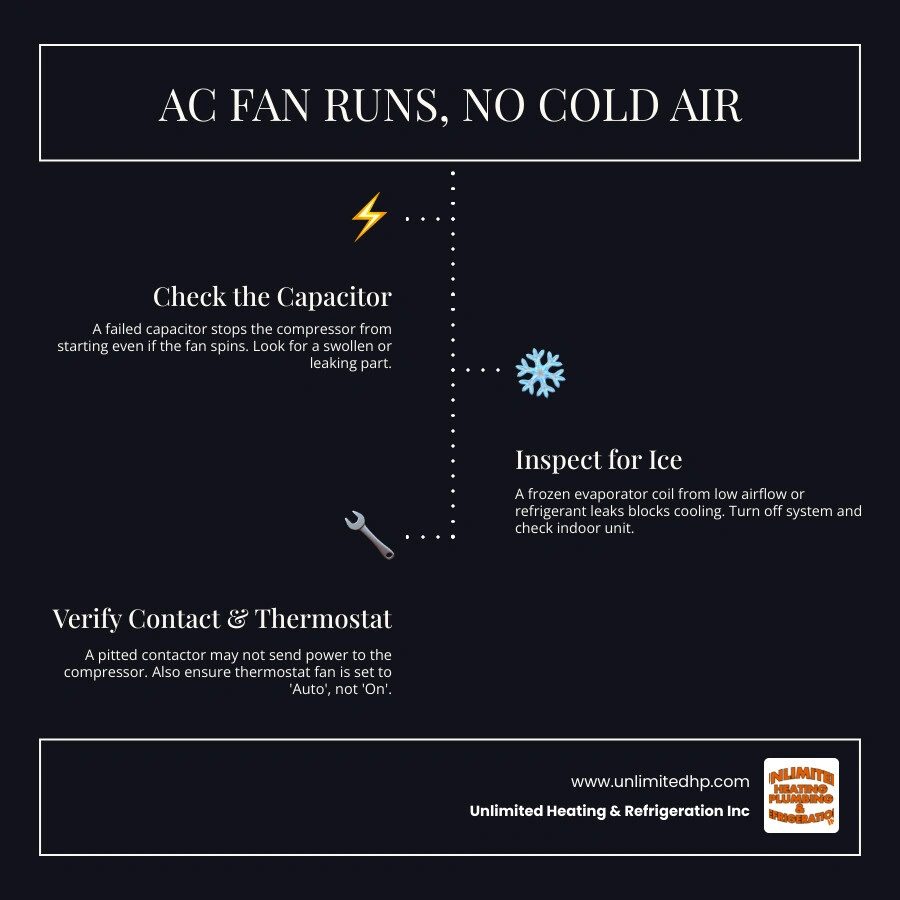
- Failed capacitor - The compressor can't start even though the fan still spins
- Frozen evaporator coil - Ice buildup blocks airflow through the indoor unit
- Dirty air filter - Restricted airflow starves the system and stops cooling
- Low refrigerant - A leak prevents the system from moving heat out of your home
- Thermostat misconfiguration - Fan set to "On" instead of "Auto" circulates uncooled air
- Tripped circuit breaker - The indoor unit loses power while the outdoor fan keeps running
- Failed contactor - The compressor never receives the signal to start
It's one of the more confusing AC problems a homeowner can face: your outdoor unit is clearly running, the fan is spinning, you can hear it humming — but step inside and the air coming from your vents is warm and getting warmer. On a hot Moscow, ID summer day in 2026, that's not just uncomfortable, it's urgent.
Here's the key thing to understand right away: a spinning outdoor fan does not mean your entire AC system is working. Your outdoor unit actually has two separate jobs — the fan dissipates heat, and the compressor pumps refrigerant through the system. When the fan runs but the compressor doesn't, you get exactly this symptom: motion without cooling.
The indoor side of your system adds another layer of complexity. A problem with the indoor air handler — like a frozen coil, a clogged filter, or a failed blower motor — can also cause the outdoor unit to keep running while no cold air reaches your rooms.
This guide walks you through exactly how to tell these situations apart, what you can safely check yourself, and when it's time to call a professional.
Explore more about ac fan running outside but no cold air inside:
- AC not cooling but running what to check first
- Frozen evaporator coil in a hot dry climate what causes it
- AC troubleshooting before calling a pro
Why is My AC Fan Running Outside But No Cold Air Inside?
To figure out why your air conditioner has turned into a giant, expensive paperweight that only blows lukewarm air, we have to look at the thermodynamic cycle. Think of your central air conditioning system as a heat transporter. It doesn't actually "create" cold air; it absorbs heat from inside your home and dumps it outside.
This process relies on a delicate balance between the indoor air handler (which pulls warm air across a freezing-cold evaporator coil) and the outdoor condenser unit (which compresses and cools the refrigerant to start the loop over again). When you have an ac fan running outside but no cold air inside, it means the mechanical airflow loop or the chemical heat exchange process has broken down.
If your outdoor fan is happily spinning away but your indoor vents are blowing air that feels like a lukewarm breeze on the Palouse, the system is failing to complete this thermodynamic handoff. You can learn more about this initial diagnostic step in our guide on AC Not Cooling But Running What to Check First.
Airflow Restrictions and Frozen Evaporator Coils
One of the most common causes of this issue is restricted airflow, which almost always leads to a frozen evaporator coil. Your indoor evaporator coil relies on a steady stream of warm indoor air to keep it from getting too cold. If that airflow is restricted, the temperature of the coil drops below freezing, and the moisture in the air turns to ice.
Once the coil is encased in ice, it acts like a thick winter coat, insulating the refrigerant lines. The system can no longer absorb heat from your home. Even worse, that block of ice physically blocks air from passing through your ductwork. You might hear your outdoor unit running, but inside, you get next to nothing.
What causes this restriction?
- A severely clogged air filter: Trying to pull air through a dirty filter is like trying to run a marathon while breathing through a straw.
- Closed or blocked vents: Many homeowners mistakenly believe that closing vents in unused rooms saves energy. In reality, it creates back-pressure that slows down airflow and can cause the coil to freeze.
- A failing indoor blower motor: If the blower motor or its capacitor fails, the fan won't spin, leading to instant freezing.
If you suspect your system has iced over, turn it off immediately. Running an AC with a frozen coil can cause permanent, expensive damage to your compressor. For a localized look at why this happens in our region, check out Why AC Is Freezing Up Lewiston.
Thermostat Misconfigurations and Communication Issues
Before you assume a major mechanical failure has occurred, look at your thermostat. It is the brain of your HVAC system, and sometimes it gets a little confused—or is simply set incorrectly.
First, check the fan setting. If your thermostat's fan is set to "On" instead of "Auto", the indoor blower motor will run continuously, even when the AC isn't actively cooling. This means that during the periods between cooling cycles, the system will blow uncooled, room-temperature air through your vents, mimicking a broken system.
Second, consider communication failures. Modern thermostats run on low-voltage wiring. A loose wire, a corroded terminal, or a dead battery can prevent the thermostat from sending the "Y" signal (which tells the compressor to turn on) while still successfully sending the "G" signal (for the fan) or vice versa. If you want to rule out simple thermostat issues before calling in the cavalry, read through our checklist on AC Troubleshooting Before Calling a Pro.
Common Causes of an AC Fan Running but the Compressor Not Starting
If your outdoor fan is spinning but you don't hear the deep, distinct hum of the compressor kicking on, you are dealing with a compressor start failure. The compressor is the heart of the system; without it, refrigerant cannot circulate, and no cooling can occur.
Identifying why the compressor won't start while the fan runs is key to resolving the issue. To learn more about identifying these specific component failures, see our guide on AC Might Need Repair and How to Identify Them.

Failed Capacitor and Contactor Issues
By far, the most common electrical culprit behind a non-starting compressor is a failed run capacitor. Think of the capacitor as a temporary booster battery. It stores up electrical energy and delivers a high-voltage jolt to help start the fan motor and the compressor.
Many systems use a "dual-run" capacitor, which houses two capacitors in a single metal canister—one side for the condenser fan, and one side for the compressor. Because they are separate electrical circuits inside the same part, the compressor side can fail completely while the fan side continues to work perfectly. This leaves your outdoor fan spinning while the compressor sits silent and idle.
During hot summer days in places like Pullman, WA or Clarkston, WA, high temperatures force the system to run constantly. This intense heat causes capacitors to degrade. A failing capacitor will often bulge or swell at the top, or leak oil.
Another common point of electrical failure is the contactor. The contactor is essentially an automatic switch that closes when the thermostat calls for cooling, allowing high-voltage electricity to flow to both the fan and the compressor. Over time, the electrical contacts can become pitted, burned, or even blocked by nesting insects (ants love the warmth of electrical contacts). If only one side of the contactor makes a clean connection, you might get a running fan but a dead compressor.
Refrigerant Leaks and Low Pressure Safeties
Your air conditioner operates on a closed refrigerant loop. Refrigerant is not "used up" like gasoline in a car; it simply circulates forever. If your system is low on refrigerant, it means you have a physical leak somewhere in the copper lines or coils.
To protect the expensive compressor from destroying itself, modern AC systems are equipped with safety switches, including a low-pressure cut-out switch. If a refrigerant leak causes the system pressure to drop below a safe threshold, the safety switch trips and cuts power directly to the compressor.
However, because the outdoor fan often runs on a separate control circuit, it may continue to spin while the compressor remains locked out. If your system has been running constantly during hot weather but slowly losing its cooling power over several weeks, a refrigerant leak is a highly probable cause. For more on how constant runtime affects your system in our local climate, read AC Running Constantly in Palouse Summer Heat.
Step-by-Step DIY Troubleshooting Checklist
When your home is heating up, it's easy to panic. However, about half of the "AC not cooling" issues we encounter can be diagnosed or even resolved by the homeowner in just a few minutes.
Below is a comparison of what you can safely check on your own versus what requires a professional diagnostic toolset:
| Diagnostic Step | DIY Friendly? | What to Look For |
|---|---|---|
| Thermostat Check | Yes | Ensure it is set to "Cool" and "Auto" with fresh batteries. |
| Air Filter Inspection | Yes | Pull the filter; if you can't see light through it, replace it. |
| Outdoor Unit Clearance | Yes | Remove weeds, leaves, and debris within 2 feet of the unit. |
| Circuit Breaker Reset | Yes | Check for a tripped breaker in your main electrical panel. |
| Capacitor Testing | No (Electrical Hazard) | Requires a multimeter and discharging high-voltage current. |
| Refrigerant Pressure Test | No (EPA Regulated) | Requires specialized manifold gauges and EPA certification. |
| Contactor Replacement | No (Electrical Hazard) | Involves handling high-voltage wiring and controls. |
What to Check First When Your AC Fan Running Outside but No Cold Air Inside
If you are standing in a warm house trying to figure out why your system is failing, follow this immediate action plan:
- Verify Thermostat Settings: Make sure it is set to "Cool" and the target temperature is at least 3 to 5 degrees below the current room temperature. Ensure the fan is set to "Auto" and not "On".
- Inspect the Air Filter: If your filter looks like a dusty charcoal briquette, replace it immediately. A clogged filter will starve the system of air and cause the indoor coil to freeze.
- Check for Ice: Look at the copper refrigerant lines entering your indoor air handler. Do you see frost or ice? If so, turn the system completely OFF at the thermostat and switch the fan setting to "On" to help thaw the ice. Do not turn the cooling back on until the ice has completely melted.
- Clear the Outdoor Condenser: Ensure there is at least two feet of clear space around your outdoor unit. Clear away tall grass, weeds, or wind-blown debris that might be choking the condenser coils.
Safe Homeowner Checks Before Calling for Service
If the basic checks don't yield results, you can perform a safe system reset. Sometimes, a power surge or minor electrical glitch can cause the system's control board to lock out.
To perform a safe reset:
- Turn the thermostat to the "Off" position.
- Go to your home's main electrical panel and locate the circuit breaker labeled "AC" or "Air Conditioner".
- Flip the breaker completely to the "Off" position, wait a full 5 minutes to let any residual electrical charge dissipate, and then flip it back to "On".
- Go back to your thermostat and set it to "Cool" with a temperature below the room reading. Wait up to 5 minutes, as most systems have a built-in delay to prevent the compressor from short-cycling.
If your breaker immediately trips again when you turn the system on, do not reset it a second time. A repeatedly tripping breaker is a clear warning sign of a severe electrical short or a failing compressor motor. Trying to force it to run can cause an electrical fire or permanently destroy your equipment. Learn more about this in our article on Why AC Trips the Circuit Breaker.
Frequently Asked Questions
Why is my ac fan running outside but no cold air inside after a power surge?
A power surge or lightning strike during a summer storm on the Palouse can easily damage the sensitive electrical components in your HVAC system. Most commonly, a voltage spike will blow the outdoor run capacitor or damage the indoor control board. If the surge damages the compressor's electrical circuit but spares the fan's circuit, the outdoor fan will continue to spin while the compressor remains completely dead. In some cases, a surge can also corrupt your thermostat's programming, requiring a factory reset.
Can a dirty air filter cause the outdoor fan to run but no cooling inside?
Yes, absolutely. A heavily clogged air filter restricts the volume of air flowing across your indoor evaporator coil. Without enough warm indoor air to keep the coil warm, the temperature of the refrigerant drops below freezing, and the moisture on the coil turns to solid ice. This block of ice physically chokes off all airflow to your vents. While this is happening inside, your outdoor unit will continue to run and spin its fan, trying in vain to dump heat that it can no longer absorb from your home.
How do I know if my AC compressor is bad or if it is just a capacitor?
When a capacitor fails, the compressor wants to start but lacks the electrical "kick" to do so. If you stand near your outdoor unit, you will often hear a distinct, rhythmic clicking sound or a loud, brief hum every few minutes as the compressor attempts to start and then trips its internal thermal overload switch. The outdoor fan will spin normally. If the compressor itself has failed mechanically (such as a locked rotor), it may make a very loud, metallic screeching sound, or it may remain completely silent and trip your home's main circuit breaker immediately every time it tries to start. A professional technician can easily verify this by measuring the capacitor's microfarads and testing the compressor's electrical windings.
Conclusion
Dealing with an ac fan running outside but no cold air inside can be incredibly frustrating, but you don't have to navigate it alone. While simple fixes like changing a dirty filter or resetting a thermostat are great DIY projects, complex electrical diagnostics and refrigerant issues require professional expertise.
At Unlimited Heating & Refrigeration Inc, we have been keeping homes comfortable across the Moscow, ID area for over 20 years. As a family-owned business and a trusted Daikin dealer, we stand behind our work with our Comfort Promise and an exceptional 12-year warranty on qualifying systems. Whether you are in Moscow, Pullman, Lewiston, Clarkston, or any of our surrounding communities, our experienced team is ready to get your cooling system running perfectly again.
If your air conditioner is running but failing to keep your home cool, don't risk damaging your compressor by letting it run. Contact us today or schedule a visit with our local experts:
What It Means When Your AC Fan Is Running Outside but No Cold Air Comes Inside
If you have an ac fan running outside but no cold air inside, the most likely causes are:
- Failed capacitor - The compressor can't start even though the fan still spins
- Frozen evaporator coil - Ice buildup blocks airflow through the indoor unit
- Dirty air filter - Restricted airflow starves the system and stops cooling
- Low refrigerant - A leak prevents the system from moving heat out of your home
- Thermostat misconfiguration - Fan set to "On" instead of "Auto" circulates uncooled air
- Tripped circuit breaker - The indoor unit loses power while the outdoor fan keeps running
- Failed contactor - The compressor never receives the signal to start
It's one of the more confusing AC problems a homeowner can face: your outdoor unit is clearly running, the fan is spinning, you can hear it humming — but step inside and the air coming from your vents is warm and getting warmer. On a hot Moscow, ID summer day in 2026, that's not just uncomfortable, it's urgent.
Here's the key thing to understand right away: a spinning outdoor fan does not mean your entire AC system is working. Your outdoor unit actually has two separate jobs — the fan dissipates heat, and the compressor pumps refrigerant through the system. When the fan runs but the compressor doesn't, you get exactly this symptom: motion without cooling.
The indoor side of your system adds another layer of complexity. A problem with the indoor air handler — like a frozen coil, a clogged filter, or a failed blower motor — can also cause the outdoor unit to keep running while no cold air reaches your rooms.
This guide walks you through exactly how to tell these situations apart, what you can safely check yourself, and when it's time to call a professional.

Explore more about ac fan running outside but no cold air inside:
- AC not cooling but running what to check first
- Frozen evaporator coil in a hot dry climate what causes it
- AC troubleshooting before calling a pro
Why is My AC Fan Running Outside But No Cold Air Inside?
To figure out why your air conditioner has turned into a giant, expensive paperweight that only blows lukewarm air, we have to look at the thermodynamic cycle. Think of your central air conditioning system as a heat transporter. It doesn't actually "create" cold air; it absorbs heat from inside your home and dumps it outside.
This process relies on a delicate balance between the indoor air handler (which pulls warm air across a freezing-cold evaporator coil) and the outdoor condenser unit (which compresses and cools the refrigerant to start the loop over again). When you have an ac fan running outside but no cold air inside, it means the mechanical airflow loop or the chemical heat exchange process has broken down.
If your outdoor fan is happily spinning away but your indoor vents are blowing air that feels like a lukewarm breeze on the Palouse, the system is failing to complete this thermodynamic handoff. You can learn more about this initial diagnostic step in our guide on AC Not Cooling But Running What to Check First.
Airflow Restrictions and Frozen Evaporator Coils
One of the most common causes of this issue is restricted airflow, which almost always leads to a frozen evaporator coil. Your indoor evaporator coil relies on a steady stream of warm indoor air to keep it from getting too cold. If that airflow is restricted, the temperature of the coil drops below freezing, and the moisture in the air turns to ice.
Once the coil is encased in ice, it acts like a thick winter coat, insulating the refrigerant lines. The system can no longer absorb heat from your home. Even worse, that block of ice physically blocks air from passing through your ductwork. You might hear your outdoor unit running, but inside, you get next to nothing.
What causes this restriction?
- A severely clogged air filter: Trying to pull air through a dirty filter is like trying to run a marathon while breathing through a straw.
- Closed or blocked vents: Many homeowners mistakenly believe that closing vents in unused rooms saves energy. In reality, it creates back-pressure that slows down airflow and can cause the coil to freeze.
- A failing indoor blower motor: If the blower motor or its capacitor fails, the fan won't spin, leading to instant freezing.
If you suspect your system has iced over, turn it off immediately. Running an AC with a frozen coil can cause permanent, expensive damage to your compressor. For a localized look at why this happens in our region, check out Why AC Is Freezing Up Lewiston.
Thermostat Misconfigurations and Communication Issues
Before you assume a major mechanical failure has occurred, look at your thermostat. It is the brain of your HVAC system, and sometimes it gets a little confused—or is simply set incorrectly.
First, check the fan setting. If your thermostat's fan is set to "On" instead of "Auto", the indoor blower motor will run continuously, even when the AC isn't actively cooling. This means that during the periods between cooling cycles, the system will blow uncooled, room-temperature air through your vents, mimicking a broken system.
Second, consider communication failures. Modern thermostats run on low-voltage wiring. A loose wire, a corroded terminal, or a dead battery can prevent the thermostat from sending the "Y" signal (which tells the compressor to turn on) while still successfully sending the "G" signal (for the fan) or vice versa. If you want to rule out simple thermostat issues before calling in the cavalry, read through our checklist on AC Troubleshooting Before Calling a Pro.
Common Causes of an AC Fan Running but the Compressor Not Starting
If your outdoor fan is spinning but you don't hear the deep, distinct hum of the compressor kicking on, you are dealing with a compressor start failure. The compressor is the heart of the system; without it, refrigerant cannot circulate, and no cooling can occur.
Identifying why the compressor won't start while the fan runs is key to resolving the issue. To learn more about identifying these specific component failures, see our guide on AC Might Need Repair and How to Identify Them.

Failed Capacitor and Contactor Issues
By far, the most common electrical culprit behind a non-starting compressor is a failed run capacitor. Think of the capacitor as a temporary booster battery. It stores up electrical energy and delivers a high-voltage jolt to help start the fan motor and the compressor.
Many systems use a "dual-run" capacitor, which houses two capacitors in a single metal canister—one side for the condenser fan, and one side for the compressor. Because they are separate electrical circuits inside the same part, the compressor side can fail completely while the fan side continues to work perfectly. This leaves your outdoor fan spinning while the compressor sits silent and idle.
During hot summer days in places like Pullman, WA or Clarkston, WA, high temperatures force the system to run constantly. This intense heat causes capacitors to degrade. A failing capacitor will often bulge or swell at the top, or leak oil.
Another common point of electrical failure is the contactor. The contactor is essentially an automatic switch that closes when the thermostat calls for cooling, allowing high-voltage electricity to flow to both the fan and the compressor. Over time, the electrical contacts can become pitted, burned, or even blocked by nesting insects (ants love the warmth of electrical contacts). If only one side of the contactor makes a clean connection, you might get a running fan but a dead compressor.
Refrigerant Leaks and Low Pressure Safeties
Your air conditioner operates on a closed refrigerant loop. Refrigerant is not "used up" like gasoline in a car; it simply circulates forever. If your system is low on refrigerant, it means you have a physical leak somewhere in the copper lines or coils.
To protect the expensive compressor from destroying itself, modern AC systems are equipped with safety switches, including a low-pressure cut-out switch. If a refrigerant leak causes the system pressure to drop below a safe threshold, the safety switch trips and cuts power directly to the compressor.
However, because the outdoor fan often runs on a separate control circuit, it may continue to spin while the compressor remains locked out. If your system has been running constantly during hot weather but slowly losing its cooling power over several weeks, a refrigerant leak is a highly probable cause. For more on how constant runtime affects your system in our local climate, read AC Running Constantly in Palouse Summer Heat.
Step-by-Step DIY Troubleshooting Checklist
When your home is heating up, it's easy to panic. However, about half of the "AC not cooling" issues we encounter can be diagnosed or even resolved by the homeowner in just a few minutes.
Below is a comparison of what you can safely check on your own versus what requires a professional diagnostic toolset:
| Diagnostic Step | DIY Friendly? | What to Look For |
|---|---|---|
| Thermostat Check | Yes | Ensure it is set to "Cool" and "Auto" with fresh batteries. |
| Air Filter Inspection | Yes | Pull the filter; if you can't see light through it, replace it. |
| Outdoor Unit Clearance | Yes | Remove weeds, leaves, and debris within 2 feet of the unit. |
| Circuit Breaker Reset | Yes | Check for a tripped breaker in your main electrical panel. |
| Capacitor Testing | No (Electrical Hazard) | Requires a multimeter and discharging high-voltage current. |
| Refrigerant Pressure Test | No (EPA Regulated) | Requires specialized manifold gauges and EPA certification. |
| Contactor Replacement | No (Electrical Hazard) | Involves handling high-voltage wiring and controls. |
What to Check First When Your AC Fan Running Outside but No Cold Air Inside
If you are standing in a warm house trying to figure out why your system is failing, follow this immediate action plan:
- Verify Thermostat Settings: Make sure it is set to "Cool" and the target temperature is at least 3 to 5 degrees below the current room temperature. Ensure the fan is set to "Auto" and not "On".
- Inspect the Air Filter: If your filter looks like a dusty charcoal briquette, replace it immediately. A clogged filter will starve the system of air and cause the indoor coil to freeze.
- Check for Ice: Look at the copper refrigerant lines entering your indoor air handler. Do you see frost or ice? If so, turn the system completely OFF at the thermostat and switch the fan setting to "On" to help thaw the ice. Do not turn the cooling back on until the ice has completely melted.
- Clear the Outdoor Condenser: Ensure there is at least two feet of clear space around your outdoor unit. Clear away tall grass, weeds, or wind-blown debris that might be choking the condenser coils.
Safe Homeowner Checks Before Calling for Service
If the basic checks don't yield results, you can perform a safe system reset. Sometimes, a power surge or minor electrical glitch can cause the system's control board to lock out.
To perform a safe reset:
- Turn the thermostat to the "Off" position.
- Go to your home's main electrical panel and locate the circuit breaker labeled "AC" or "Air Conditioner".
- Flip the breaker completely to the "Off" position, wait a full 5 minutes to let any residual electrical charge dissipate, and then flip it back to "On".
- Go back to your thermostat and set it to "Cool" with a temperature below the room reading. Wait up to 5 minutes, as most systems have a built-in delay to prevent the compressor from short-cycling.
If your breaker immediately trips again when you turn the system on, do not reset it a second time. A repeatedly tripping breaker is a clear warning sign of a severe electrical short or a failing compressor motor. Trying to force it to run can cause an electrical fire or permanently destroy your equipment. Learn more about this in our article on Why AC Trips the Circuit Breaker.
Frequently Asked Questions
Why is my ac fan running outside but no cold air inside after a power surge?
A power surge or lightning strike during a summer storm on the Palouse can easily damage the sensitive electrical components in your HVAC system. Most commonly, a voltage spike will blow the outdoor run capacitor or damage the indoor control board. If the surge damages the compressor's electrical circuit but spares the fan's circuit, the outdoor fan will continue to spin while the compressor remains completely dead. In some cases, a surge can also corrupt your thermostat's programming, requiring a factory reset.
Can a dirty air filter cause the outdoor fan to run but no cooling inside?
Yes, absolutely. A heavily clogged air filter restricts the volume of air flowing across your indoor evaporator coil. Without enough warm indoor air to keep the coil warm, the temperature of the refrigerant drops below freezing, and the moisture on the coil turns to solid ice. This block of ice physically chokes off all airflow to your vents. While this is happening inside, your outdoor unit will continue to run and spin its fan, trying in vain to dump heat that it can no longer absorb from your home.
How do I know if my AC compressor is bad or if it is just a capacitor?
When a capacitor fails, the compressor wants to start but lacks the electrical "kick" to do so. If you stand near your outdoor unit, you will often hear a distinct, rhythmic clicking sound or a loud, brief hum every few minutes as the compressor attempts to start and then trips its internal thermal overload switch. The outdoor fan will spin normally. If the compressor itself has failed mechanically (such as a locked rotor), it may make a very loud, metallic screeching sound, or it may remain completely silent and trip your home's main circuit breaker immediately every time it tries to start. A professional technician can easily verify this by measuring the capacitor's microfarads and testing the compressor's electrical windings.
Conclusion
Dealing with an ac fan running outside but no cold air inside can be incredibly frustrating, but you don't have to navigate it alone. While simple fixes like changing a dirty filter or resetting a thermostat are great DIY projects, complex electrical diagnostics and refrigerant issues require professional expertise.
At Unlimited Heating & Refrigeration Inc, we have been keeping homes comfortable across the Moscow, ID area for over 20 years. As a family-owned business and a trusted Daikin dealer, we stand behind our work with our Comfort Promise and an exceptional 12-year warranty on qualifying systems. Whether you are in Moscow, Pullman, Lewiston, Clarkston, or any of our surrounding communities, our experienced team is ready to get your cooling system running perfectly again.
If your air conditioner is running but failing to keep your home cool, don't risk damaging your compressor by letting it run. Contact us today or schedule a visit with our local experts:
Customer Testimonials
Our customers love our service and support.


